Skip to content

Taxonomy term

Content type

Leading the next phase of We Are Undefeatable

What better way to start the new year than with an exciting new role to get your teeth into?

In January, I joined the Richmond Group of Charities as the new programme director leading the We Are Undefeatable physical activity programme following a significant stint running behaviour change programmes in the active travel sector.

With Sport England funding recently confirmed up to March 2028, it was a great time to join the team and get cracking.

A busy year from the start

We Are Undefeatable is a game-changing programme, bringing together an impactful behaviour change campaign with thought-leading policy, and influencing work to support and encourage people with long-term health conditions to be active in ways that work for them.

Throw in a new strand of place-based pilot work starting later this year, plus lived experience voices underpinning all we do, and we’ve got a huge amount to offer the sector and our key audiences.

So, unsurprisingly, this year is shaping up to be an exciting one already.

To kick us off in January we launched our new place-based approach, inviting expressions of interest from a range of areas, all of whom are already connected to the Sport England place expansion work.

Our place-based work will build on our experiences so far working with Blackburn with Darwen and Lancashire on local versions of the We Are Undefeatable campaign to support places to embed systems change, increase opportunities for movement and frictionless pathways to physical activity for those with long-term health conditions. We look forward to announcing our new partnerships in the spring.

Earlier in February, we held our inaugural Lived Experience Network session.

This group will be pivotal as we move into the next phases of the programme, ensuring we are keeping the experiences and perspectives of our key audiences at the heart of our deliverables.

It’s also already proving valuable to our partners (including the Faculty of Sport and Exercise Medicine and the Active Partnerships National Organisation on the Moving Together programme), tapping into key expertise as meaningful contributors to work in development.

We’ll be lining up more opportunities for this collaborative working over the year and will continue to demonstrate to our network the impacts of their involvement.

In January we launched our new place-based approach, inviting expressions of interest from a range of areas, all of whom are already connected to the Sport England place expansion work.

The power of storytelling feeds through to our marketing efforts, with a social media influencer campaign and summer activation in development.

For it, we’ll be building on our previous successes with one in five people taking action having seen the campaign, 64% of people finding our advertising relatable and 66% agreeing that the campaign stands out from other advertising. Our insight hub offers more details about the response to the campaign.

And, while more details will come in due course, keep an eye out for a summer campaign and how you, and your networks, can get behind it.

Evaluating past efforts and looking ahead

While a lot of our lobbying and influencing work goes on behind the scenes, we’re particularly excited to kick start work on a follow up to our impactful Millions More Moving report from 2024 to see progress made against the policy shifts we set out to influence.

This time we’ll be going into it with greater depth on how and why to get millions more moving.

We’re also proud of our continued work on shaping the implementation of the 10 Year Health Plan, which will provide a focus for our lobbying and influencing work.

Our Lived Experience Insights Dashboard helps to inform our influencing work, so we’re delighted that this resource continues to be freely available for anyone who wants to access it as it now spans several years’ worth of data from 13,000 respondents with long-term conditions.

And finally (yep, there’s still more!), we’re heading into year two of having our very own app, which we’re about to get the first 12-month evaluation back from (thanks to GoodBoost and London Metropolitan University for working with us on that).

A sneak peek shows increases in physical activity for those engaging with the app and increases in personal motivation to be more active, which we’re thrilled to see.

With over 13,000 users registered already, this is a promising start to a fundamental part of the behaviour change journey for our audiences.

With such a busy year ahead there’s great cause for optimism that in 12 months' time we’ll have taken huge strides to achieving our goals within our role as a system partner and across our wider sector.    

Find out more

We Are Undefeatable

The closer the problem, the nearer its solution

Oxfordshire is one of ten early testers for Place Universal Offer (PUO) funding in England and we’ve used this support to turbo-charge our community-driven work to tackle systemic inequalities and to get more people moving.

With Oxfordshire becoming a Marmot Place, proportionate universalism is writ large in our work as a system.

PUO investment gives us a practical opportunity to provide a universal offer of leadership training, supporting work in culturally-competent ways, upscaling what works and sharing learning; all whilst, simultaneously, focusing more intensely on where needs are greatest and inequalities are most stark.

The role of Community Anchor Organisations

Our belief is that the closer we are to the challenges, the nearer we are to finding their solutions too.

PUO work is more than simply starting from scratch or creating new projects or programmes.

Instead, it’s about identifying community leaders in priority areas who already understand their barriers and have trust within their own communities.

PUO is also about working with and through them to create the biggest impact, and it’s about listening far more than talking and being ready to learn and shift the way that we work to optimise processes and results.

That’s why we have made a deliberate choice to work with a small number of Community Anchor Organisations in our priority neighbourhoods, including Oxford Community Action.

By working in this way, we can put lived experiences at the front and centre in the creation of solutions.

What difference is being made so far?

Whilst it is early days for our PUO journey, we are seeing some positive early signs that reinforce how it’s possible to enable both short-term action and long-term systemic shifts.
 

PUO is about identifying community leaders in priority areas who already understand their barriers and have trust within their own communities.

Communities can’t wait years for change, and they shouldn’t have to, but PUO funding has enabled us to start creating the environments needed for long-term change to empower action now.

The conditions defining these new environments are:

  • an increase in referrals from communities in priority areas into sport and physical activity interventions, which have proven to decrease inactivity and to improve wellbeing
  • regular dialogue with community leaders, which has strengthened our organisational knowledge and our understanding of community matters
  • direct community feedback and collaborative work with national governing bodies and their constituent clubs, which has resulted in the creation of new provisions, especially Sunnah activities
  • placing community needs at the front and centre of physical activity opportunities, which has resulted in five grassroots organisations receiving support to sustain these activities by Oxford Community Action
  • more upstream, systemic conversations taking place about how community groups can access leisure, sport and activity more easily.

Key learnings so far

So how has all this work helped us grow?

These are the key learnings that we’d like to share in case they can help others too:

  • Community leaders are not just vehicles through which communities can be reached and physical activity delivered. They are strategic trailblazers and face the same challenges as any other leads. In fact, the stakes on them are arguably higher as they live, work and play in the communities they serve.
  • Community work is a 24/7 job for community leaders. Organisationally, they need to be prepared to work differently. As one community leader told us: “For us, this is our live". We need to demonstrate that we truly care and want to make a difference to successfully build trust to undertake place-based work.
  • We need to be ready to step out of our comfort zone and be prepared to really listen to understand and speak honestly with each other.
  • We aim to blur the line between organisations, so there’s no more “us and them” and the system and communities see each other as part of the same team.
  • By working through Community Anchor Organisations, our network and reach naturally grow to include people and organisations we may not have met otherwise. This allows for the rapid growth of movement, as each person and organisation in turn introduces more people and organisations to this way of working.

We are six months into our three-year PUO journey and are really excited by early learnings and future potential.

This is a system-wide effort, with organisations like Oxford Community Action at the heart of change and, together, we are working to create healthier futures for the residents of Oxfordshire.
 

Preventing crime from the ring

Boxing is my religion. Like all spiritual journeys it began with a moment of divine inspiration and my baptism was conducted whilst watching Muhammed Ali defeat George Foreman in “The Rumble In The Jungle”.

I grew up in boxing gyms with the sport giving me purpose, discipline and titles – including representing my country on numerous occasions.

These days it offers me the chance to inspire the next generation of boxers and to help anyone who walks through the gym door, to believe in themselves and choose a positive path in life. 

When people ask me why boxing matters so much to me, my answer is simple: it changes and saves lives.

A safe space for all

Of course, it also improves health and builds confidence, but boxing keeps people – especially young people – away from anti-social behaviour and crime, something that I can personally verify as a former Youth Justice Manager. 

With the number of proven offences committed by children seeing an increase of 4%change has never been so important and there are many ways boxing helps fight crime.

Firstly, boxing gives young people structure and boundaries.

Many of the children and young people who walk through the doors of a boxing gym – like mine in Oldham, Greater Manchester – come from difficult backgrounds and have challenging lives. 

Having little or no access to opportunities and therefore a lack of agency in the world, may result in challenging behaviours. But not dealing with these pressures means they risk spilling out onto the streets and that’s where crime starts. 

Not because young people are 'bad', but because they have nowhere positive to pour their energy into. But boxing gyms can change that, as these spaces are built on discipline, respect, routine and team spirit.

Boxing gyms offer me the chance to inspire the next generation of boxers and anyone who walks through the gym door, to believe in themselves and choose a positive path in life.

You don’t just turn up to your gym whenever you feel like it. Instead, you’re expected to train on time, plus you have to listen to your coach, and you learn that effort leads to results and that shortcuts rarely work.

These lessons transfer directly into everyday life and children who understand discipline in a boxing gym are far less likely to make reckless decisions outside it.

Boxing also teaches emotional control, becasue contrary to what some may think, this sport helps a young person understand how to control their emotions, particularly aggression, and how to think and act under pressure.

I’ve seen it first hand – children who once lashed out can calm themselves because boxing gave them an outlet for their emotions and that allows them to thrive.

The many lessons of boxing

Boxing is a good metaphor for life and can help to develop those personal and social skills that people need, contributing to tackling deep seated worklessness and low aspirations.

The sport also fosters the development of positive character, self-esteem, self-discipline, courage, perseverance and resilience.

Instead of throwing punches on the street, they hit the pads, the bags and their coach or opponent inside the ring, but always with respect to the sport’s rules, under supervision and with a reason.

Boxing also teaches respect — for yourself and for others. You shake hands, you follow rules and you learn that real strength comes from self-control, not intimidation. These values reduce crime at its roots.

Another factor that's key is the sense of belonging among those practising the sport. A boxing gym offers identity and loyalty because, at a gym, you’re part of a team.

You train together, look out for each other and you wear the gym name with pride. That sense of identity can pull someone away from a path that leads to anti-social behaviour and crime.

I’ve seen boxing change lives in Oldham and Greater Manchester, where young people that were heading toward trouble now have focus and a reason to stay on the straight and narrow, and I’ve also seen young people who had no confidence, find self-belief.

Not all these children will become a champion boxer and that's okay.

Building better lives through sport

The real victories happen when a young person chooses to stay in school, can find a job or simply chooses not to commit a crime because they don’t want to let their gym or coach down.

At our newly refurbished Greater Manchester Boxing and Development Hub, we’ve been lucky enough to benefit from Sport England funding. 

To my mind, our investors aren’t just putting money into a boxing club and community gym. They’re investing in crime prevention and harm minimisation.

It costs less to fund a gym than it does to deal with the consequences of crime and anti-social behaviour policing, court cases, prison and reform  as recent estimates place the total economic and social cost of serious youth violence at £11 billion between 2009 and 2020.

For me, boxing is more than titles and trophies, it’s about giving people a chance.

Every time a young person chooses to walk into a gym and away from 'the road', I believe that’s crime prevention in action and that’s why boxing will always matter. 

As one of the 10 boroughs of Greater Manchester, Oldham forms part of Sport England’s Place Partnership with Greater Manchester Moving and other local bodies to implement Sport England's Uniting the Movement strategy for getting people active.

I’m proud of what boxing can do to change lives.

In the words of the iconic social activist, pacifist and politician, Nelson Mandela: “Sport can awaken hope where there was previously only despair.

Every day, I get to see the truth in these great words in action.
 

Making winter sports accessible and inclusive

As the Milano Cortina 2026 Winter Olympic and Paralympic Games start we would like to extend our very best wishes to the athletes and the support team behind Team GB (and in the coming weeks ParalympicsGB) as the spotlight of Olympic and Paralympic sport shines upon them.

It is worth remembering that during the 2018-22 cycle the winter sports and athletes were particularly impacted by the resultant post-Brexit travel restrictions and also (how soon we forget!) by the Covid pandemic.

UK Sport and the British Olympic Association have an ambitious target this year and I think, and hope, that at this iteration of the ‘winters’ we will see our athletes and sports realise their aspirations as they showcase the rich and diverse sporting offer we have in England and across the UK.

Proudly supporting our talent

At Sport England we are extremely proud of the role that we play in supporting partners and thereby enabling aspiring athletes in winter sports to explore and fulfil their potential, but what does that support look like and why does it matter?

Starting with the second question first, let’s address the elephant in the room – why winter sports?

There is a rather lazy misconception that we don’t have winter sports facilities and that those sports are exclusively the pursuit of people from affluent backgrounds – the truth, like many things in life, is much more nuanced that that.

Starting with the sliding sports (bobsleigh, skeleton or luge to name a few) there is an established track record of athletes coming from the British Army - shout out at this point to our colleagues at British Army Sport which continues to be a key partner of and contributor to the UK High Performance System - or from track and field athletics.

These athletes often transition in to sliding sports (or should it be pushing sports!) through established UK Sport-led talent ID programmes such as Find Your Greatness, and those sports have brilliant pathways to take them all the way to the podium.
 

At Sport England we are extremely proud of the role that we play in supporting partners and thereby enabling aspiring athletes in winter sports to explore and fulfil their potential.

The skating sports are typically populated with athletes who started their careers at ice rinks and ice centres scattered across the major ‘second cities’ of England.

Funding centres across the country

The National Ice Centre in Nottingham has long since been the base for aspiring short track speed skaters and a great partnership between Sport England, Nottingham City Council and recently British Ice Skating, who received Sport England talent funding into their pathways.

Other English rinks feature prominently in the athletes’ biographies and it was great to see Sheffield hosting the recent Figure Skating European Championships as part of the build up to the Games.

English Snowsport athletes often start their careers at outdoor ‘dry’ (not so much in the rain!) ski slopes, which continue to be popular and affordable community sport facilities, enabling athletes such as the Summerhayes sisters or, for Milan-Cortina, veteran James ‘Woodsy’ Woods (who will compete at his fourth Olympic Winter Games) to progress from Sheffield Ski Village to the X-Games podium.  

Arguably Great Britain's most successful ever Alpine skier, Dave Ryding will contest his fifth Olympic Winter Games, having purportedly earned his stripes at a dry ski-facility up at Pendle Ski Club, a member-owned club located in the Ribble Valley, Lancashire.

Sport England investment supports the talent pathways in a range of winter sports to ensure that performance pathways in these sports are accessible and inclusive, well-led and managed, and that they offer the support needed to allow our aspiring young people to progress to the very highest level.

Through our funded partners, most prominently SportsAid, we also fund programmes such as Backing The Best and the TASS programme that collectively provide direct financial and athlete support services, such as strength and conditioning, physiotherapy and sports medicine services to enable our players to be fit, healthy and optimally prepared for graduation into high performance programmes and success at major events and games.

As an example, of the Team GB class of 2026 in Milan-Cortina, at least 10 athletes (including Dave ‘The Rocket’ Ryding) have received Sport England support through TASS - five of which are current TASS-supported athletes enabling them to be in the very best of health as they embark on one of the biggest events of their careers.

Finally, as we look ahead to the winter Paralympics, we could not be prouder of the English athletes who will represent PGB as the spotlight shines on them from 6 March, I am particularly looking forward to seeing trailblazing English wheelchair curlers: Yorkshire’s Jo Butterfield, Newcastle’s Jason Kean, Wigan’s Karen Aspey and Northumbria’s Stewart Pimblett.

Collectively, they will make history as the first English curlers ever to take to the ice at the ‘winters’.

Their inspirational journey (look them up, their stories are remarkable) was enabled through an innovative partnership with British Curling, which saw Sport England invest in performance pathways in the sport for the very first time.

Best of luck to all our athletes. No need to ask you to make us proud. We already are.
 

Find out more

Talent

Consents

A football coach stands beside equipment bags on the sideline of a football match on a playing field on a summer's day, with mature trees in the background. Information on consents required for projects or activities funded by us, including restrictions or charges registered at the Land Registry. Funding Governance

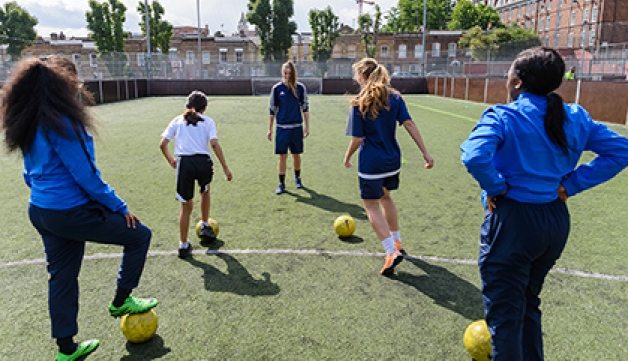
Let’s make 2026 the year every child is active

Children and young people today are creative, passionate, and full of potential.

Their energy and ambition feel hopeful in a world that often feels uncertain and unstable.

But they’re also facing new challenges: social media addiction, rising mental health concerns, climate anxiety.

In 2025, parents, teachers, and leaders across the country voiced concerns about a growing disconnect between online and offline life.

School absence is rising; wellbeing is worsening. And physical inactivity remains a stubborn problem: more than half of children aren’t active enough.

The inequalities are stark. Children from less affluent families are far less likely to be active than wealthier peers.

Girls remain less active than boys, and Black and Asian children are less likely to be active than White children.

If these trends continue at pace, we could be heading for a children’s health crisis within a decade.

The Youth Sport Trust’s (YST) Class of 2035 report warns that without robust action, we’ll see soaring screen time, rising obesity, disengagement from education, and more children diagnosed with diseases like Type 2 diabetes – a condition once almost exclusive to adulthood.

But this isn’t a story of despair, it’s a call to action.

And the good news? We are making progress - and 2025 was testament to this.

Promising Signs of Progress

In December 2025, Sport England data shows children’s activity levels are now at their highest since the first Active Lives Survey in 2018.

Half a million more children are meeting the UK Chief Medical Officers’ guideline of 60 minutes of activity a day compared to seven years ago.

That’s thanks to the incredible work of schools, clubs, and community organisations and the people that run them.

Government action has also been integral.

The National Youth Strategy can be a landmark moment, creating more opportunities for young people to connect offline - and sport has a huge role to play.

Its emphasis on being shaped by young people is vital: policy done with young people, not to them.

The commitment to halt the decline in PE and ensure at least two hours of reimagined PE each week is another big step forward, as is the ambition to increase access to enrichment activities.
 

If these trends continue at pace, we could be heading for a children’s health crisis within a decade.

The new PE and School Sport Partnerships Network can build on past progress.

Campaigns like Let’s Move from the Department for Culture, Media and Sport (DCMS) and YST’s Inclusion 2028 programme (funded by the Department for Education) show what’s possible when national leadership meets local delivery.

Let’s Move is inspiring families to get active together.

Inclusion 2028 is empowering children with special educational needs and disabilities (SEND) to thrive through PE, school sport, and physical activity.

These initiatives prove that inclusive change is possible - and it’s already happening.

All this is happening against the backdrop Sport England’s £250m investment in place-based partnerships across more than 90 communities.

Why Movement Matters and Our Vision for 2026

Physical activity is often called the 'miracle cure' by medical experts - and for excellent reason.

It boosts physical and mental health, reduces stress and improves mood. And it’s a social salve too, helping to forge friendships and build connection across communities in the face of the polarising online world.

It’s also fantastic for people and the public purse; every £1 invested in community sport and activity generates over £4 for the economy and society.

School and community sport aren’t 'nice to have'; they’re essential for healthy development.

Research consistently shows us that active children are happier, more resilient and perform better at school.

And building good activity habits young is key for our country’s future health and wealth: active children are more likely to become active adults who enjoy better health, greater productivity and place less strain on the NHS.

That’s why we need to make movement easy and normal everywhere: in schools, communities, families, parks, and urban spaces.

This means working with partners beyond education, like UK Youth and community sport organisations, to embed activity into where young people live and socialise.

Sport England’s place partnerships have some fantastic examples of this happening from the ground up – from JU:MP in Braford to Move Together Blackpool.

Young people must be at the heart of this change. They want experiences that are fun and engaging; not just minutes of activity to be ticked off to hit targets.

Here’s what we think just some of the opportunities to achieve getting every child active in 2026 are:

  • a return to longer school breaks to give children more time to move and play.
  • increasing uptake of Always Active Uniform, building on new national guidance and making being active easier and more comfortable – particularly for girls and children with SEND.
  • greater restrictions on social media use for children, to free up time and attention for real-world play.
  • protecting the real-world places and spaces that children get active and play in
  • advocate for child-first coaching: supporting coaches to give children and young people voice and choice in physical activity. The Play their Way campaign is a fantastic example of child-first coaching in action.  

By rethinking existing policy and being bold, we can create system-wide changes that deliver a healthier, happier future for every child.

Our Mission and Call to Action

Our mission is clear: to inspire a generation that loves to move by making physical activity and everyday movement a normal part of life - giving every child 60 minutes of PE, sport, and play every day.

This is a cornerstone of Youth Sport Trust’s Inspiring Changemakers, Building Belonging strategy and Sport England’s next phase of Uniting the Movement. Working with schools, communities and families, we will redouble our efforts to create experiences that build the foundations for an active life.

Together, we can create a future where every child and young person has the opportunity to move, connect and thrive through sport and physical activity.
 

Find out more

Youth Sport Trust

You've viewed of items.