Skip to content

Taxonomy term

Content type

One team. One power. One dream

To some, 'devolution' might sound like a dry constitutional tweak – another layer of governance, another reshuffling of power. 

In reality, it’s actually far more human and ultimately, it’s all about people.  

For us in Greater Manchester, devolution has always been about who gets to shape the conditions of everyday life and about enabling those closest to the challenges to also have the power to solve them.

This is what drives us to go further and deeper on our devolution journey.

Facing reality

Back in 2009, the Manchester Independent Economic Review set out two stark truths.

Firstly that if the city-region acted as one joined-up place, it had the potential to help re-balance the UK economy; and secondly, that poor health in the area was holding people back from participating in that growth.  

In some of our neighbourhoods, healthy life expectancy still differs by more than a decade and access to employment, housing, green space and opportunity remains uneven.

These problems are one and the same because health and wealth inequalities are deeply intertwined, and physical inactivity is at the heart of it, yet this isn’t a result of personal choice but a product of environment, policy, culture and design work.  

Movement and physical activity have often been engineered out of daily life, especially in communities facing the greatest disadvantage.

By 2015, when the first Greater Manchester Moving strategy – Blueprint for Change  was developed, the data was clear.

Where inequality was top level, inactivity was also the highest; and the costs – financial, social and human – were enormous.

A true change of tactics against inactivity

The price of inactivity was at least £27 million a year and far higher if you took into account the cost of long-term conditions, mental health, social isolation and the impact of exclusion.  

The response couldn’t be another short-term campaign or an isolated programme. The people of Greater Manchester deserved better.

We needed to reshape the whole system – from transport to planning, from health to education and from workplaces to public spaces.  

This meant a shift from blaming individuals for being inactive and unhealthy (indeed 55% of people in our city-region wanted to be more active), to redesigning the conditions that were shaping their behaviour.

Movement and physical activity have often been engineered out of daily life, especially in communities facing the greatest disadvantage.

Devolution in Greater Manchester, along with the support of key partners like Sport England, has made that kind of systemic change possible.

This approach has made it possible to have power over health, transport, housing and skills for the people and places they affect but, more importantly, it has enabled us to work differently. 

The way we work now is rooted in collaboration across ten boroughs, public services, communities and sectors. We are one team! 

In Greater Manchester, prior to devolution, we already had the foundations and had laid the groundwork for this approach as we have a history of cooperation that stretches back generations. 

Devolution accelerated that instinct and drive as it gave us the space and opportunity to align strategies, pool resources and focus on our shared mission of building a thriving city-region where everyone can live a good and active life. This is making a difference.

Evidence suggests that life expectancy has improved faster than expected since devolution, particularly in more deprived areas.  

Employment, school readiness and public health outcomes have all shown signs of progress.  

In terms of physical activity, Greater Manchester reduced inactivity at nearly three times the national rate before the pandemic and has since recovered more quickly.

The latest data shows that in Greater Manchester, 62.1% of adults are now considered active. This is the highest rate ever recorded and there is further progress too, with inactivity falling to 26.9%, down from 28.3%.

Data shows that activity levels for children and young people in Greater Manchester are also the highest they’ve been since the survey began in 2017 and, currently, 50.1% of those aged 5-16 are active for at least 60 minutes a day.

But inequalities remain, particularly for people living in more deprived areas, lower socio-economic groups and for some ethnic communities.

So, while this is encouraging progress, a continued focus is needed to enable active lives for all and to keep the MIER report front of mind.

Moving forward as one

These changes are the result of systems that are maturing, where there is better alignment between local and regional strategies, stronger partnerships, and growing trust across sectors.  

They also reflect a deep cultural change in leadership that drives everything we do.

Here, leadership is more than job titles and institutions – it’s relational, distributed and rooted in a shared purpose. 

Leadership seen in community groups is as important as that of boardrooms because, for us, it is about convening, listening and connecting. 

We are united by the same goal of helping people see how movement links to the issues they care about, from jobs and growth to mental health and climate.

Devolution supports us in this work, but it doesn’t guarantee it. Local power alone isn’t enough and mindsets, behaviours and relationships matter just as much.  

The instinct to collaborate doesn’t come from governance structures alone – it comes from people and that’s the real lesson here.

Whether a place has formal devolved powers or not, the fundamentals still apply and it all starts with a shared vision.  

We use a central community voice, work collaboratively across boundaries and build trust by aligning efforts around outcomes that matter.

Our journey in Greater Manchester’s is far from finished (we are only five years into our 10-year Active Lives for All strategy), but we are an example of what is possible when a place brings together its people, purpose and power. 

To my mind, devolution isn’t about redrawing maps. It’s about redesigning systems so that everyone – regardless of where they live – has a fair chance at a good life.

Why sport has become central to our history

When many people think of Pride, they picture crowded streets, loud music and a little too much drinking.

But after four years serving on the Board of Pride in London, I began to feel there was space and a real need for something different to express new ways for our community to come together.

Wellbeing opportunities

As we emerged from lockdown, many people in my sapphic community told me they were craving spaces centred around wellbeing, nature and the outdoors. 

A group of women play football outdoors next to some camping tents.

They wanted connection, but in a way that felt restorative rather than overwhelming and that’s how Out & Wild Festival was born.

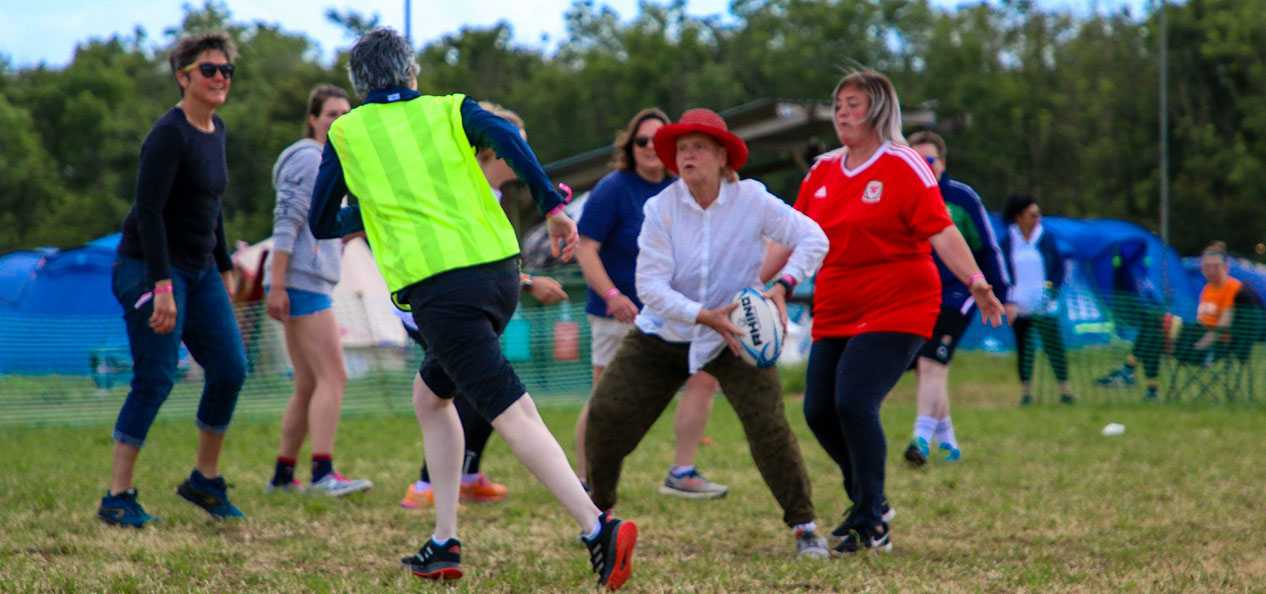
From the beginning, sport has played an important role in the festival and, over the years, we’ve offered a wide range of activities including touch rugby, football, golf, archery, swimming, tennis and daily guided hikes. Last year, a group of attendees even took part in a local parkrun.

If I’m honest, I wasn’t sure sport would work in a festival setting, but it quickly became one of our most popular offerings.

Something for everybody

As a festival created for queer women and non-binary people, we offer something many attendees struggle to find elsewhere  a genuinely safe and supportive environment in which to be active.

For many people, traditional sporting spaces can feel intimidating or exclusionary, but being surrounded by a supportive community makes all the difference.

At the same time, the festival is an opportunity for some to try something completely new like wild swimming  whereas for others it’s about reconnecting with a sport they haven’t played in years, like football.

Whether it’s a team activity or an individual challenge, people participate together and that shared experience creates an immediate bond.

That matters, especially when more than 30% of our attendees come to Out & Wild on their own.

And because wellbeing is at the heart of everything we do, we’ve always understood the value of movement, not just for physical health, but for mental wellbeing too.

In fact, one of the most rewarding things has been seeing attendees discover a new activity at the festival, fall in love with it, and continue to practise it once they return home.

As a festival created for queer women and non-binary people, we offer something many attendees struggle to find elsewhere – a genuinely safe and supportive environment in which to be active.

In my case, it was watching the joy on people’s faces after one of our first wild swims that inspired me to launch the UK’s first-ever Pride Swim in 2023.

Swimming is such an accessible sport, welcoming people of all ages, abilities and backgrounds.

We took a pause this year, but we’re excited to bring Pride Swim back in 2027 in partnership with an LGBTQ+ charity. Watch this space!

Looking ahead to 2026, we’re returning to Devon for our second year.

With the coast just a short drive away, we’ll be offering sea swims and surf sessions and we’re currently in talks with Devon Cricket about hosting a relaxed beach cricket session.

We’ll also be partnering with a local outdoor centre to deliver stand-up paddleboarding, archery and mountain boarding too, while our run coach will lead a Saturday morning group run.

Looking out for more activity partners

Our ambition is to grow Out & Wild to more than 2,000 attendees over the next two years, and sport will be an integral part of that journey.

We’ve already worked with a number of governing bodies – particularly in Wales, where the festival first launched – and we’d love to build more partnerships in the future, not only at the festival itself but through the year-round events we now run.

We’re excited to keep finding sport and physical activity opportunities for the LGBTQ+ community, so if you're a sporting organisation looking to engage with these groups in meaningful ways, we’d love to hear from you.

This year the Out & Wild Festival will take place from 3-6 July in Bideford, Devon, so come and join us to celebrate and take advantage of the amazing offerings from our festival.

Everybody is welcome!

Find out more

Out & Wild Festival

The future of inclusive sport

From the bloodandthunder drama of para ice hockey (I challenge anyone to watch a match and not feel exhausted) to the debut of mixed doubles curling, the Milano Cortina 2026 Paralympics Winter Games delivered far more than sporting excellence.

We’ve witnessed what human potential looks like when barriers are removed and inclusion is real, but climate change is shifting and rebuilding those barriers – making them higher, harder and, for some, insurmountable.

This is because climate change exacerbates inequality, threatening the hard-won gains made by disability activists over decades and, while progress has been huge, the extreme change in our weather and its effects on Earth are a stark reminder of how fragile that advancement is.

We even saw the impact of climate change at the Games, with some athletes voicing concerns that the March schedule for the event is now too late in the year and that competition conditions were being impacted by warm 'spring-like' weather.

The lesser known dangers of climate change 

Evidence submitted to Parliament is unequivocal: disabled people are more negatively affected by the health and social impacts of climate change than the general population – not primarily because of their impairments – but because systems already fail to meet their basic needs.

People living with disabilities – who are already twice as likely to be inactive according to our research, but who gain the most for their wellbeing from being able to take part in sport and physical activity – are disproportionately affected by rising heat, greater flooding risk and disruptions to accessible transport.

Sport England’s mission is to enable more people take part in sport and activity, but extreme weather is already making that harder.

From washed-out pitches to heatwaves that make outdoor sport unsafe, extreme weather has already prevented three in five adults in England from being active.

Climate research consistently shows why this happens and it’s simple and disheartening – disabled people are routinely excluded from climate adaptation planning.

Globally, 80% of national climate strategies fail to reference disability, leaving huge gaps in preparedness and emergency support.

And wherever disabled people are mentioned at all, they are often labelled as ‘inherently vulnerable’ – a misconception that shifts responsibility away from systems that fail to include them.
 

We’ve witnessed what human potential looks like when barriers are removed and inclusion is real, but climate change is shifting and rebuilding those barriers – making them higher, harder and, for some, insurmountable.

When torrential and constant rain hits it’s harder to manoeuvre a wheelchair outside. When a ramp floods, when accessible transport is disrupted, when a facility closes ‘for a few days’, some people lose far more than a chance to exercise. They lose independence, community and joy.

If we want to protect the magic of sport and movement – plus the hard-won progress of inclusion in sport for people with disabilities – we must protect the planet that makes sport possible.

That is why Sport England’s mission to help people get active now include helping the planet stay stable.

In May 2024, we launched Every Move, our first environmental sustainability strategy, to help the 150,000 sports clubs and 98,000 facilities across England sitting on the frontline of climate impacts.

We backed this with more than £45 million of National Lottery funding and already more than 570 interventions are underway, including solar panels on roofs, energy efficient systems in leisure centres or redesigned outdoor spaces to cope with flooding.

These changes cut carbon and also keep facilities open, safe and accessible for the communities who depend on them most.

On top of these, all of our partners must have sustainability action plans in place by March 2027 as a funding condition.

This isn’t a box-ticking exercise, but about futureproofing the places and spaces that people rely on to stay active, healthy and connected as communities, including our swimming pools, village halls, football pitches or athletics tracks, to name a few.

Community action agains climate change 

It’s great to see how sport is willing to innovate to face the disrupting weather conditions.

Football and all-weather pitches are working with us to explore transitions away from rubber infill and to increase recycling capacity, with the ambition to be the first in the world to have a fully sustainable system by 2035.

Elsewhere, leisure centres are switching to more efficient systems and community clubs are testing and implementing changes.

Be it the guys at Whalley Range Cricket & Lawn Tennis Club, who are planting trees on the outskirts of playing fields to better soak up excess water, or the river clean-ups hosted by Fulham Reach Boat Club – an organisation doing great work through Row to Rhythm, a project for individuals with visual impairments.

Actions like these collectively truly add up to major impact.

Going back to international competitions, the challenges facing the Winter Paralympics, and winter sport more widely, should not drive despair. They should galvanise us instead, because sport has always been about rising to the moment and responding to the now.

And right now, the moment demands that we confront climate change not just as an environmental issue, but as a justice matter – one that threatens to undo decades of progress in making sport accessible, inclusive and transformative.

If we want a future where Paralympians can still inspire the world from real snow and real ice, and where disabled people everywhere can access the benefits of movement, we must act together and we must do so right now.
 

Sport and youth crime prevention

For more than ten years I’ve led the Sport and Safer strategy at StreetGames – a national sporting organisation committed to bringing sport to the doorsteps of young people in underserved communities.

Ten years of partnerships. Ten years of learning. Ten years of seeing what happens when sport shows up consistently where it’s needed most, and here’s what I now know: a decade of sport and youth crime prevention has changed many young people’s lives through sport, but we’re only getting started.

The policy moment is here

The conversation has changed.

Government strategies now talk about Safer Streets, Youth Matters, Child Poverty, Pride in Place, Freedom from Violence and Abuse and Fit for the Future.

And the common thread in all of these? That place matters, prevention matters and community matters.

The Government’s emerging Young Futures Programme – particularly its Prevention Partnerships and Hub model.

At StreetGames we have been doing something similar: identify vulnerable young people, focus on those in the 30% most underserved communities, connect them with trusted adults and engage them through high-quality, hyper-local sport, via a network of Community Partners.

The evidence has grown up

A decade ago, much of our work was powered by instinct and experience, but today it’s backed by robust research.

Our Theory of Change – Sport, Youth Offending and Serious Youth Violence was authored by Loughborough University, resourced by the Youth Endowment Fund and shaped with input from Sport England.

It sets out clearly how sport can reduce risk factors linked to youth offending while strengthening protective factors that keep young people safe.

That theory underpinned the Ministry of Justice’s £5m Youth Justice Sport Fund, which now informs more than a dozen place-based partnerships with Active Partnerships, Police and Crime Commissioners and Violence Reduction Units.

This isn’t theory gathering dust, but action that's shaping investment and practice, and that proves that when sport is delivered intentionally, it protects.

Why sport on the doorstep works

At StreetGames, we focus on doorstep sport – making it accessible, affordable and local. But this isn’t just about keeping young people busy. It’s about building identity.

Well-designed sport creates trusted adult relationships, safe spaces in the heart of communities, positive peer networks, emotional regulation and self-control, plus a sense of belonging.

These are protective factors – and protective factors matter.

A decade of sport and youth crime prevention has changed many young people’s lives through sport, but we’re only getting started.

When young people feel seen and connected, they are less likely to engage in harm and when they feel pride in their street or estate, they are less likely to damage it.

Doorstep sport also changes how places feel. A park filled with organised activity feels different. A street reclaimed for play feels different.

Putting a value on wellbeing

But ultimately, why does this matter?  Recently, we commissioned State of Life to conduct a social value study.

The research organisation looked at survey data from around 1,000 young people taking part in StreetGames’ doorstep sport, which many had entered through youth crime prevention pathways.

Using the WELLBY approach set out in HM Treasury’s Green Book guidance, the study estimated that the wellbeing uplift associated with participation equates to approximately £12,986 per young person, assuming the improvement lasts for one year.

That’s not a participation statistic. That’s the wellbeing value of doorstep sport.

Raising the bar

Our current Youth Endowment Fund-backed evaluation, Towards Sport, is using randomised control trials – the gold standard in evaluation. Results will land next year and we can’t wait!

But one thing is already clear: sport must be intentional. It must understand referral pathways. It must align with youth justice priorities. It must embed strong monitoring and learning. It must work in partnership, not in isolation.

Over the last decade, as a sporting organisation, we’ve become fluent in the youth justice system’s language – concepts and phrases such as trusted adults, contextual safeguarding, public health principles, system impact – and its significance.

This understanding has led us to a key learning: sport cannot simply turn up. It has to fit.

A decade in and still learning

We know many of Sport England system partners and Active Partnerships are active — or increasingly curious — in this space.

That’s encouraging because prevention is long-term work that requires humility, partnership and constant learning.

There is still more to understand and strengthen but the direction is clear.

Ultimately, this work is about supporting place-based community partners to support and protect vulnerable young people, getting them more physically active along the way. 

Think pro-social (not anti-social), build protective factors (not just manage risk) and, above all, use sport not as distraction, but as deliberate prevention and keep putting it where it works best and is needed the most.

These subjects, and more, will now become a series of deep-dive webinars that will be delivered in partnership with Sport England and the Active Partnerships National Organisation (APNO), and you can access the Quarterly Learning Session we had last week with Sport England. 

Together we will get more young people into sport and physical activity and away from crime.

Making physical activity fun for all

At Get Doncaster Moving (GDM) we have a mission: to support the youngest in our society and their families to be as active as possible, because the benefits of moving are something that will accompany them for the rest of their lives.

It is with that mission in mind that across Doncaster, partners within our network are working together to create the conditions to help children, young people and their families build healthier, more active lives.

Through a place-based approach, the network is enabling innovative programmes, unlocking new partnerships and supporting communities to develop sustainable activity habits.

This is something we’ve undertaken as a long-term mission.

A group of poeple pose around a Pokemon ball that's been painted on park's floor.


Thinking outside the pitch

Reflecting on the past year, there are some stand out examples of how innovative partnerships have been the key driver behind GDM’s work to support children and young people – and their families – to move more.

Firstly, we’ve been developing new outdoor experiences to help children and families connect with local parks in different ways.

For example, GDM’s partnership with Enigma.Rooms introduced interactive digital trail games in parks across the city that engaged new and younger audiences through fun problem-solving and exploration.

The initiative was a success and contributed to Hexthorpe Park receiving the national ‘Green Space Innovation Award’ in 2025.

Then in November, and thanks to the efforts of the local Pokémon community, Doncaster was selected to host a Pokémon GO: Community Celebration event (the first place in Europe be chosen!), attracting thousands of local players and visitors.

The trails across two major parks showcased Doncaster’s green spaces while promoting movement through play.

Through a place-based approach, the network is enabling innovative programmes, unlocking new partnerships and supporting communities to develop sustainable activity habits.

GDM is continuing its work with local Pokémon Go group ‘Raiding Doncaster and beyond’ to grow this welcoming, inter-generational walking and gaming community, and encouraging new players to engage in this family-friendly activity, and to move more – particularly within Doncaster’s parks and green spaces.  

Trying something new

In sport, the ‘Free Park Tennis’ initiative started a couple of years ago in a local park to expand opportunities for children and families.

Resident volunteers have been trained as Free Park Tennis Activators to deliver free, weekly sessions to the community in two Doncaster parks, which led to one park being awarded ‘Park Venue of the Year’ by Yorkshire Tennis.

Our most recent park venue to host Free Park Tennis sessions, Haslam Park, which started in May this year, has already seen 369 attendances, with four local volunteers upskilled to deliver the weekly sessions.

This has been a fantastic opportunity for people to come along and 'have a go' at tennis in a relaxed and social setting, and it has been very popular with both children and families.

Doncaster’s place-based model played a key role in connecting partners and enabling the Active Start initiative, a programme designed for staff working with children aged 2–5.

Active Start is led by Yorkshire Sport Foundation, working in partnership with, and funded by, the South Yorkshire Integrated Care Board's Children and Young People’s Alliance. Their latest Impact Report: Giving children an Active Start is full of learnings and data.

This information is key to the training and resources they provide to early years professionals to help embed movement and active play throughout everyday learning.

This approach not only supports physical development but also communication efforts, social skills and school readiness, giving children the strongest start in life.

Doncaster’s Public Health and Early Years teams have trained as tutors, offering one-on-one support, continuing professional development opportunities and resources to nurseries, schools, childminders and all 12 family hubs, which are places for families to go within their communities to access groups and support.

Many settings have already taken part in centralised training and are now better equipped to encourage movement in class and at home.

But this is not all, because work will continue into the 2025/26 academic year as the programme develops further across South Yorkshire.          

Looking ahead, shifting the dial on children’s engagement in activity will require continued place-based collaboration.

Sustained shared learning, creativity and innovation – alongside a connected, empowered GDM network – will help Doncaster’s young people to move more, play more and thrive.

Find out more and connect with us

One dance step at a time

Silent Steppers is a joyful blend of walking, dancing and mindset coaching, all delivered outdoors through silent-disco headsets.

Picture a mixed group of around 50 people moving along seaside promenades, parks and coastal walkways – everyone listening to the same uplifting music while receiving real-time encouragement, positivity and coaching through their headphones.

It’s energetic, inclusive and completely different to traditional indoor exercise. And so much fun, too!

A group of Silent Steppers pose by the sea after one of their exercise sessions.

What began as a personal healing tool has evolved into a community movement that people across the UK now travel to to experience.

Often taking 10,000 steps in an hour or simply letting the music lift their mood, us Steppers leave the session feeling lighter, stronger and more connected to ourselves, and to each other.

How it all began

Silent Steppers actually started during one of the hardest chapters of my life. After suffering a trauma, I found myself walking outdoors to clear my mind.

On these walks, I’d listen to music and quickly realised how the world softened inside that musical bubble.

The lyrics felt more meaningful, my thoughts slowed down and, for a short time, I could switch off from everything I was carrying on my shoulders.
 

Picture a mixed group of around 50 people moving along seaside promenades, parks and coastal walkways – everyone listening to the same uplifting music while receiving real-time encouragement, positivity and coaching through their headphones.

With a background as a qualified dance teacher, senior mental health lead and life coach among others, and with over 25 years teaching trauma-informed approaches, I invited a few colleagues to join me for a music-assisted walk.

I chose songs that helped me heal, put on the headset mic and coached them through the session.

The effect was instant. The energy was electric. Silent Steppers was born! 

A community that keeps growing

Fast forward under a year and Silent Steppers now has hundreds of participants every week that include children, right through to our oldest Stepper aged 83.

We train in all weather – rain, wind, sun and/or coastal gales – and the tougher the conditions, the more bonded the group becomes.

Alongside our main sessions, we now run Steady Steppers, a slower-paced, mobility-friendly version designed for those with disabilities, injuries, chronic conditions or lower fitness levels.

These sessions offer the same music, the same mindset coaching and the same sense of achievement, just at a pace that feels safe and accessible for everyone involved.

The physical and mental impact across both groups has been extraordinary and participants have reported improvements of different kinds like weight loss, better fitness levels, plus better balance, coordination and confidence.

Others have mentioned being able to return to exercise after cancer treatment or joint replacements, a reduced reliance on mental health medication (always under GP guidance), stronger mobility and the ability to jog for the first time in years, and, overall, significant improvements in mood, stress levels and wellbeing.

And if all of that wasn’t enough, overwhelmingly, people describe Silent Steppers as their escape – an hour where they can lose themselves, breathe differently and feel part of something special.

The outdoors connection

Taking Silent Steppers into outdoor public spaces has created something truly magical.

We dance-walk along promenades, move through parks, train beside the sea and often stop people in their tracks who just smile when they see us.

Week after week, members of the public pause to watch us, cheer us on, take photos or even start dancing as we pass. People tell us we’ve made their day, how amazing we look or how we lift their mood. 

Many now recognise us and come back each week just to see us in action because our group's energy is infectious.

These interactions have become part of the heartbeat of Silent Steppers, and proof that movement and joy ripple far beyond the people wearing the headsets.

Challenges and what we’ve learned

I must admit, however, that with popularity comes challenges.

We only have 60 headsets, which means waiting lists of 25+ people are becoming common.

I’m also frequently asked to run sessions across the UK – and even internationally – but with existing commitments, it simply isn’t possible.

However, I’ve now excitedly trademarked licensing training that'll launch in the new year, which will create opportunities for Silent Steppers leaders in towns and cities nationwide.

There are other key lessons we’ve also learned:

  • When exercise is fun, people stick to it – many of our steppers are a year in and saying it’s the only thing they’ve ever stuck too.
  • Authenticity matters, as people connect with honesty and real stories.
  • Listening to the community and adapting accordingly is essential.
  • Music profoundly changes the movement experience.
  • Mindset coaching and Natural Language Processing (NLP) techniques amplify the emotional impact.

The future of Silent Steppers

The combination of music, scenery, encouragement and community creates an empowering, accessible and inclusive atmosphere that translates into a wellbeing experience unlike any other.

It fills me with pride that what started as a personal coping mechanism has now grown into a nationwide wellbeing model, supporting hundreds every week.

I also love that Silent Steppers is reshaping how people view exercise, mental health and community connection.

Silent Steppers is proving that exercise can be enjoyable at any age and ability. One dance step at a time.

Staying out of lane

Bristol Stepping Sistas is more than a walking group – it’s my walking group. Mine and that of the amazing women who've walked with me since 2021.

Together we are an award-winning walking group that enables us to reach out to other women in the Bristol area and encourage them to thrive in open spaces through the simple (yet powerful) activity of walking.

At the core, we are a grassroots group of Black women and women of colour who are passionate about walking and who want to share their identity and their lived experience.

We started to apply for funding so the group could carry on as it offers a well-needed support and it was great when Sport England was able to help us.

We regularly organise walks and we aim to cover different distances to keep our activities interesting for everybody, whether you want to stay close to home or you fancy venturing further. 

In any case, our aim is to help motivate women of colour to visit places they would not have ventured to otherwise, including rural areas around Bristol and further afield in the South-West; routes, all of them, that can be of interest for our women beyond the city borders.

Why we do what we do

Historically, women of colour have not always been up for exploring new, unfamiliar spaces where they feel they could be exposed, judged and/or remarked upon.

This has led to the feeling that we have to 'stay within our lanes', but at Bristol Stepping Sistas we want our women to break any limitation and stay out any of those lanes, so we can all thrive in the new experiences that come with that change of scenery.

We want to encourage women to step across these boundaries (physical and non-physical) and push their limits but, at the same time, to do so in the safety and the company of others who may have had similar experiences of discrimination and disadvantage.
 

Our aim is to help motivate women of colour to visit places they would not have ventured to visit otherwise, including rural areas around Bristol and further afield in the South-West.

Ultimately, we want to enable the activity of walking to be fun, uplifting and enriching to the lives of women of colour, regardless of their walking experience.

Because, for us, walking is more than putting a foot in front of the other and we're definitely not here to cover distances within a set time.

We couldn't care less about that!

At its core, the group is about walking but we use it as an excuse and an opportunity to chat, to reflect and to thrive in nature.

We use the enjoyment and appreciation of open spaces and environments to help address issues of mental health, which I can see have been on the increase in the last few years.

More than walking

So when we meet, we walk and talk about ourselves, our cultures, our favourite dishes and ingredients.

We mention recommendations of new places to go on holidays, other groups we may know and love, and we do all of that while enjoying the fresh perspective that only nature can give us.

So, basically, we talk and we walk, and then we walk and we talk some more. It’s brilliant!

There’s been some excellent feedback from the members that mention how Bristol Stepping Sistas has been a positive, life-changing experience for them.

Our typical walking day is always about fun and there are so many smiles and so much laughter coming from our women, plus our sessions also allow us to meet new members in the group.

There has been a lot to learn in the last four years, but organising the walks is super exciting and every time we go out I look forward to seeing our walkers enjoying and embracing the environment and, of course, improving their wellbeing.

At the end of the day we may end up in a cosy country pub for a well-deserved recovery lunch to get some energy back. It really is great!

As well as creating Bristol Stepping Sisters, I have also provided the first aid outdoor training for 24 women from the group, from which I’m happy to say we’ve all passed!

I’ve also provided the walk leader training for six other women from the group.

My dream is that, together, we keep walking and enjoying every step we take, breaking any fear or boundaries that dare stay in our way.
 

Find out more

Bristol Steppin Sistas

Running, representation and resilience

Movement has always been more than exercise for me.

My first motivation was staying healthy and trying to stave off hereditary diseases like hypertension and diabetes that run in my family (and, so far, I'm happy to say it has worked!).

But movement quickly became my outlet, my reminder that I am alive, capable and able to set goals.

The power of movement

When I lace up my trainers and step outside, I am not only moving my body. I am moving through history, community and identity, and I am claiming me. I do this for me.

This year the theme for Black History Month is ‘Standing Firm in Power and Pride’, highlighting the resilience and contributions of the Black community, and I am reminded that movement has long been a form of resistance, survival and celebration for Black people.

From dance to sport, movement has always been our way of claiming space, telling stories and showing strength and, for me, running is my chosen form of movement. It gives me freedom, resilience, and connection – three qualities that shape how I live and lead.

Growing up, I saw elite athletes who looked like me on TV, but I did not see everyday women like me running.

Running was not something I thought belonged to me as an adult (child me, yes, because children always run), but the first time I tried it outside as an adult, something shifted – it was not about speed or medals, it was about finding a rhythm that was mine.

Over the years, running has carried me through joy and pain.

It has helped me navigate life’s challenges, from grief and motherhood to menopause and leadership, and it has also changed how I see myself, not as the fastest or the best, but as someone who shows up, puts one foot in front of the other and keeps going.

This year the theme for Black History Month is ‘Standing Firm in Power and Pride’, highlighting the resilience and contributions of the Black community, and I am reminded that movement has long been a form of resistance, survival and celebration for Black people.

Running has also shown me how much representation matters.

There have been times I felt invisible at races or out of place in running communities, but when I began sharing my story and weaving my Jamaican heritage into my running, I discovered others felt the same and that, by stepping forward, I could help them feel seen.

Showing the real deal

That is why I am proud to be part of the advisory board for This Girl Can.

For the Phase Six of the campaign, we have focused on showing women as they truly are: sweaty, busy, imperfect and joyful.

Not polished versions of women exercising effortlessly, but showing real women making time for movement in the midst of their busy lives.

Being on the advisory board has given me the chance to share my perspective, especially around the barriers that Black women face in sport.

From worries about hair care, to feeling unsafe in certain spaces, to simply not seeing ourselves represented, these are real issues that stop many of us from moving freely.

Phase Six is about breaking those barriers down and telling a wider story of who belongs in movement.

This new stage of the campaign is also about making sure that when women see the campaign, they see someone who looks like them, lives like them and feels like them. Because when you can see yourself, you start to believe you belong.

From local to national

In 2019, I founded Black Girls Do Run UK.

What began as a small idea, creating space for a handful of Black women to run together, has grown into a nationwide community, because we are more than a running group. We are a family!

We celebrate milestones, we share struggles and, more than anything, we create spaces where Black women can move without judgement or stereotype.

Alongside leading the community, I hold both the Leadership in Running Fitness and Coaching in Running Fitness qualifications.

These have allowed me to support runners of all abilities, from beginners to those chasing big milestones, and to bring structured, safe and inclusive coaching into our spaces.

For us, running is not about chasing times, and all about creating a memory bank, not metrics.

It is about laughing mid-race, stopping for photos and supporting each other at the back of the pack. It is about belonging.

Together in strength

Black Girls Do Run UK exists because representation matters.

Too often, Black women are absent from the imagery of running, but by showing up in our kit at races and online, we are rewriting that narrative. We are saying we are here, we run and we belong!

For me, movement is freedom. It is the freedom to be myself, to take up space and to live well in my body and during Black History Month, that freedom feels especially powerful.

We honour the struggles of those before us, celebrate the present and move with hope for those who will come after because movement connects past, present and future.

It reminds us that while the barriers are real, so is our resilience, and it proves that when women move, communities move and change becomes possible.

So this Black History Month, I celebrate movement in all its forms: the steps, the strides, the miles and the memories. Movement has shaped me, and I will keep moving, for myself, for my community, and for the generations yet to come.

You've viewed of items.