Skip to content

Taxonomy term

Content type

Understanding Asian communities

Have you ever wondered what may help someone feel like they belong in sport? This may sound like a simple question, but the answer is often deeply personal.

For some, it's feeling welcome when they arrive; for others, it's seeing people who share similar experiences, cultures or backgrounds to them. And sometimes, it's simply knowing that a space was designed with them in mind.

The Asian Sports Foundation (ASF) recently announced a new partnership with parkrun UK, which is built around a shared commitment to better understanding the experiences of Asian communities and exploring how more people can feel connected to physical activity.

Starting with conversations

We know that sport and physical activity can have a powerful impact on our health, wellbeing and sense of community.

But Sport England's latest Active Lives Adult Survey highlights that participation levels among some South Asian communities remain lower than the national average, and that health inequalities continue to exist.

While data can help us understand trends, it does not always tell us why people choose not to participate, what challenges they experience, or what would encourage them to get involved.

That is why the focus of this partnership is not to assume solutions, but to listen.

Over the coming months, ASF and parkrun will work together to engage with people from Asian communities, gathering insights and lived experiences to better understand what helps people feel welcome, what barriers may exist, and what opportunities there are to create more inclusive environments.

The importance of belonging

Parkrun has become a familiar part of many communities across the UK.

Every Saturday morning, thousands of people come together to run, walk, volunteer and connect with others.

Yet experiences of physical activity can vary significantly from one person to another, as what feels accessible and welcoming for some may feel unfamiliar or intimidating for others.

Understanding those differences is essential if we want to create opportunities that genuinely work for everyone.

At ASF, we believe that increasing participation starts with understanding communities, not speaking on their behalf.

By putting ‘listening’ first, we can help ensure that future actions are informed by the people they are intended to support.

Experiences of physical activity can vary significantly from one person to another, as what feels accessible and welcoming for some may feel unfamiliar or intimidating for others.

The CEO of ASF, Shazia Ali, has worked in the research industry for nearly 30 years and champions the importance of hearing real human stories to ensure that real people and communities are behind strategies developed.

A personal perspective

For instance, for Raheema Mamodo, joining parkrun led to a sense of connection she wasn't expecting.

Her first parkrun experience was for her graduation run at the end of Couch to 5K and she confessed she had "no idea of what to expect when the run leader suggested we attend".

Raheema mentioned it felt “overwhelming” being surrounded by runners, yet she felt welcomed straight away and loved all the cheering from fellow participants.

They made her feel like she belonged in that space too and she's carried on attending parkrun since that first event over seven years ago.

Having recently achieved her 250-parkrun milestone, Raheema's experience highlights the powerful role that welcoming environments can play in helping people stay active.

Looking ahead

South Asian Heritage Month is an opportunity to celebrate the rich contribution of South Asian communities across the UK. 

It is also an opportunity to listen, learn and better understand how sport and physical activity can be more inclusive for everyone.

ASF and parkrun are at the beginning of that journey.

By working alongside communities, hearing different perspectives and learning from lived experiences, we hope to build a stronger understanding of what belonging in physical activity really means and how more people can be supported to take part in ways that work for them.

Because lasting change starts with listening and, by walking together, we go further.

Find out more

Asian Sports Foundation

Too hot to move?

As England continues to experience a period of sustained heat, the latest evidence suggests that spells of extended hot weather are becoming an increasingly important difficulty when trying to be active.

Following the June heatwave, our Activity Check-in has shown that 71% of adults said they had experienced extreme heat during the previous 12 months.

Among those who had to endure extreme heat, 73% said they had done less sport and physical activity as a result.

Our study also says that the proportion saying the weather in the previous seven days was not suitable for being active increased almost fivefold, from 5% in August 2025 to 24.5% in June 2026.

Cost, time and confidence have long been recognised as obstacles to being active. These findings suggest that prolonged periods of hot weather are becoming another.

Not that hot weather is anything new. But the frequency of occurrence and the new highs reached are challenging resilience, and can turn opportunities for taking part in sport and physical activity from merely uncomfortable to unattainable for many individuals and communities.

Extreme weather is often framed in long-term and global terms, but it is undoubtedly already shaping when and how people take part in sport and physical activity today.

A hotter climate is already here

The past two years have shown how quickly weather patterns are changing.

June 2025 was England's warmest June on record, with two heatwaves during the month and temperatures across parts of eastern and south-eastern England around 3°C above the long-term average.

That record was surpassed in just one year as June 2026 then became England's new warmest June on record with a mean temperature of 17.1°C and temperatures reaching 37.7°C during the heatwave towards the end of the month.

For the sport and physical activity sector this is no longer simply an environmental challenge. Heat is becoming a participation issue.

Previous research has already shown that climate change risks widening existing inequalities in sport and physical activity.

These latest findings build on that picture, suggesting that prolonged periods of hot weather are already affecting people's ability and willingness to be active.

What did we find?

We compared findings from two Activity Check-in surveys: one from August 2025, shortly after the June 2025 heatwaves; and one from June 2026, carried out immediately following that month's heatwave.

The proportion reporting exposure to extreme heat during the previous 12 months almost doubled, increasing from 37% in August 2025 to 71% in June 2026.

Among those who had experienced heatwaves, 73.2% said they had done less sport and physical activity because of them, compared with 63.1% in August 2025.

When asked about barriers to activity, there was also a marked increase in the number saying the weather was not suitable for being active during the previous seven days.

While both surveys followed record-breaking periods of hot weather, the latest findings suggest the June 2026 heatwave had an even greater impact on participation.

As England continues to experience a period of sustained heat, the latest evidence suggests that spells of extended hot weather are becoming an increasingly important difficulty to being active.

Why does heat affect participation?

There is still more to learn about exactly how prolonged heat affects participation in England, but there are several likely factors.

For some, particularly older adults and those living with long-term health conditions, exercising in high temperatures can become physically more demanding and may raise concerns about health and safety.

This means these groups, along with disabled people, may experience the greatest challenges during prolonged periods of heat - showing how the impact of extreme weather is unlikely to be felt equally.

Heat can also reduce opportunities to be active.

Outdoor spaces may become uncomfortable or unsafe to use, organised activities may be adapted or cancelled, and travel disruption can make it more difficult to reach facilities.

Even where opportunities remain available, motivation can change.

When daily life already feels harder because of heat, being active may feel less appealing or less manageable.

What does this mean for grassroots sport?

Let’s face it – the climate crisis is already affecting how sport is delivered.

Grassroots sport relies heavily on outdoor facilities, volunteers and community organisations.

Many clubs are already managing the impacts of flooding during winter only to face hard, dry pitches and prolonged periods of hot weather during the summer months.

Climate impacts already cost grassroots sport circa £320 million annually in repairs and lost income.

These effects are not distributed evenly, with more deprived communities often more exposed to climate hazards and with fewer resources to respond.

This reflects a broader picture emerging from our Horizon Scanning work: climate change is increasingly shaping when and where people engage in sport and physical activity.

More frequent extreme weather, alongside changing travel patterns and sustainability goals, is expected to influence participation over the coming years.

These findings suggest those longer-term trends are already beginning to play out.

The sector has adapted to changing patterns of participation before and high heat may become another long-term trend that influences how people choose to be active.

Understanding those changes early gives the sector the opportunity to adapt before they become embedded.

With action now, sport can become more resilient, inclusive and sustainable.

Building the evidence

Our data allows us to understand how people's experiences change as events unfold, rather than relying on reflection months later.

Capturing people's experiences immediately after periods of extreme heat has helped us to better understand who is most affected, how behaviours change and where adaptation may be needed.

If you'd like to explore the findings in more detail, our Activity Check-in interactive dashboard includes data on activity levels, motivation, attitudes and barriers to participation, alongside climate-related questions, for both adults and children and young people.

Looking ahead

Heatwaves are becoming a more familiar feature of life in England.

Climate change is no longer happening somewhere else or is an issue for the future. It is shaping experiences and behaviours today.

For the sport and physical activity sector, the challenge is understanding what this means for participation, who is most affected and how we respond.

By continuing to build our understanding of how weather influences participation, we can help the sector adapt to support everyone to be active safely, confidently and consistently in the years ahead.

If you'd like to share your experiences or explore the findings in more detail, we'd love to hear from you.

Find out more

Our Activity Check-in

Why the IWG Global Summit matters

As part of my role at Sport England I’m in Birmingham for the IWG Global Summit and I can’t wait to see what these three days will teach us.

Every four years, the summit brings together people from across the world who are passionate about helping more women and girls enjoy the benefits of sport and physical activity.

The event is a chance to share ideas, challenge assumptions, celebrate progress and, perhaps most importantly, learn from one another.

Time to talk, to listen and to learn

At Sport England, our mission is to help more people improve their lives through sport and physical activity and, by investing National Lottery funding, we work with partners, places and communities across the country to tackle the barriers that prevent people from being active.

This year the summit has been supported by £920k of National Lottery money, helping us – once again – to support great causes to help improve lives and communities across the country.

Our award-winning campaign This Girl Can is one part of that wider work.

Over the 11 years since we launched our first TV spot, we’ve learned a huge amount about helping more women and girls move in ways that feel right for them.

But we also know we don’t have all the answers, so that’s exactly why opportunities like this to gather, discuss and learn from one another matter so much.

As part of Sport England’s contribution to the summit, I’ll be speaking alongside my Sport England colleague Kate Peers, Claire Norman from Active Wellbeing Society and Maxine Mills-Smith from Dolphin Women’s Centre.

Together we’ll be sharing the story of This Girl Can, not simply by celebrating what the campaign has achieved but by exploring the practical lessons behind it, because lasting change has never been about advertising alone.

Our work is about combining insight, investment, trusted partnerships and local communities to create opportunities that genuinely work for people.

This Girl Can is one expression of that holistic approach: a campaign shaped by the women it’s there to serve, and one that's brought to life by the organisations and communities who make meaningful improvements in people’s everyday lives.

Every four years the summit brings together people from across the world who are passionate about helping more women and girls enjoy the benefits of sport and physical activity.

In this amazing job, we've also learnt that the best ideas rarely stay where they’re born –  instead, they evolve and they grow because people share them, question them, reshape them and bring them to life in their own communities.

Ultimately, the greatest success isn’t about replication – it’s when an idea becomes so rooted in a place that people forget it ever came from somewhere else.

Growing together

That’s the conversation I hope we’ll contribute to in Birmingham.

I want us to discuss moving from awareness to action, how to turn insight into local change, and how we create environments where more women and girls feel that they belong.

So I’m just as excited to spend time listening as I am speaking.

Every country has its own stories, innovations and hard-won lessons, and gatherings like this remind us that none of us have all the answers.

The opportunity to hear different perspectives, discover new approaches and bring fresh ideas home is every bit as valuable as taking to the stage.

It will also be wonderful to catch up with friends and former colleagues who have helped make this summit happen, and with many of the people who were there in the early days of This Girl Can.

Because campaigns like ours are never built by one person or one organisation – they’re the product of years of collaboration, imagination and determination of many amazing individuals who come together to create something bigger, brighter and better than what we could have achieved individually. And I love it.

Celebrating our gains...

The timing feels significant too.

We’ve seen incredible progress for women and girls in sport over the last decade and (thankfully!) conversations have changed, representation has improved and more women are finding activities they enjoy and places where they feel they belong.

In fact We Like the Way You Move – the latest phase of This Girl Can – has focused on helping more women overcome fear of judgement and get active in ways that work for them.

Our research revealed some interesting points, including:

  • over four million women have been inspired to get active since 2015 and 53% of women recognise the campaign
  • 69% of women say it made physical activity feel more possible and 47% of women on lower incomes say it boosted their confidence
  • among lower socio-economic group women who recognise the campaign, 76% say it increased understanding that even 10 minutes of activity brings immediate benefits, while 69% say it made activity feel possible and 37% say it prompted them to do more sport and exercise. 

But it’s not like we can say that progress isn’t inevitable ​and, around the world, many of the barriers that inspired This Girl Can still exist.

...while working on the future together

New challenges continue to emerge and we can’t assume the progress we’ve made will simply look after itself.

If anything, this is the moment to keep listening, keep learning and keep working together.

It feels fitting that the UK is hosting this year’s IWG Global Summit before the baton passes to Brazil in 2030.

The way I see it, welcoming colleagues from around the world is both a privilege and a reminder that no one country owns the answers – we all have something to contribute and we all have something to learn.

I’m looking forward to three days of ideas, conversations, practical inspiration and, hopefully, a renewed sense of what’s possible.

If you’re in Birmingham this week, please do come and say hello. I want to listen to you.

Find out more

The IWG Summit

Changing population, changing participation

England is changing and not just around the edges.

Who we are as a nation, how we live, where we live, how long we live for and what we need to stay well are all shifting. And while these changes are gradual, their impact on sport and physical activity will be profound.

That is the central message running through Sport England’s latest Horizon scanning series on demographics.

Together the three reports offer a clear, evidence-led, picture of how population change is reshaping participation, demand and delivery, and why the sector cannot afford to stand still.

Because if we want sport and physical activity to stay relevant in ten years’ time, we have to design for the realities people are living today.

These reports are a prompt – and a practical steer – for all of us to build offers that reflect modern lives, strengthen belonging and reduce inequality rather than unintentionally reinforce it.

But this is not me presenting a distant future or abstract trends.

These shifts are already happening and they are already influencing who feels welcome, who takes part and who is being left behind.

Identity, belonging and a more complex England

Our first report focuses on identity and belonging.

It highlights how England’s population is becoming more diverse and how identities are becoming more complex and intersectional – changes that make communities harder to define, to understand and to monitor when using traditional approaches.

If we want sport and physical activity to stay relevant in ten years’ time, we have to design for the realities people are living today.

This first analysis also points to the way life stages are shifting – becoming more individual and less defined by chronological age – and it argues that sport and physical activity approaches should focus less on age, and more on lifestyle and life stage.

The opportunity for the sector is significant as sport and physical activity can foster social cohesion, but only if opportunities and the workforce reflect diverse interests and needs, and if communication and language barriers are tackled to make opportunities accessible.

Ageing, health and widening inequalities

The second report turns to ageing, health and disability.

England’s population is ageing and becoming more diverse in later life, with the report noting that the older population will continue to grow and diversify, reshaping what ageing looks like for future generations.

It also highlights a crucial tension: more people will live longer in good health, but inequalities in health outcomes are deepening, shaped by factors including income and ethnicity.

This creates diverging experiences of later life and a clear imperative for inclusive and accessible opportunities that reflect diverse needs. 

The report is equally direct about the role of sport and physical activity in prevention, supporting physical health, mental wellbeing, independence and social connection, and the responsibility the sector has to act intentionally where inequality is most entrenched.

Generations, place and the geography of opportunity

Lastly, the third report focuses on generations and place, and how geography shapes participation and delivery.

It describes how England remains separated by socioeconomic background and how economic uncertainty risks widening gaps between social groups and reinforcing existing regional inequalities.

It also points to urbanisation pressures alongside the risk of decline or disconnection in some rural and coastal communities and the role that sport and activity can play as community anchors, with local clubs sometimes doubling as social and support hubs.

For young people the report emphasises that their experiences are changing in fundamental ways – shaped by digital environments, evolving education landscapes and pressures on wellbeing – all of which affect how, where and why they engage in sport and physical activity. 

A moment for leadership

What links all three reports is a consistent conclusion: population change is not a side issue for sport and physical activity, but a defining challenge of the next decade.

These demographic shifts cut across policy, funding, workforce, facilities, design and delivery.

They challenge outdated assumptions about who participates, why they participate and what participation even looks like in modern England.

But they also present a powerful opportunity: to listen more closely to lived experience, to work across sectors and to design opportunities that reflect real lives rather than idealised ones so that sport and physical activity can play a central role in building a healthier, more connected and a more equal England.

The question is not whether change is coming. It already has. The question now is whether the sector is bold enough to respond.

Find out more

Horizon scanning

Moving Together

Health care professionals and those in physical activity alike recognise the considerable benefits of movement as medicine.

For too long, people who stand to gain the most from increasing their physical activity have been faced with systemic barriers that serve to undermine their confidence and autonomy.

These barriers are not rooted in evidence, so addressing them requires a collaborative, system-wide response shaped by the voices and lived experiences of those with long-term health conditions.

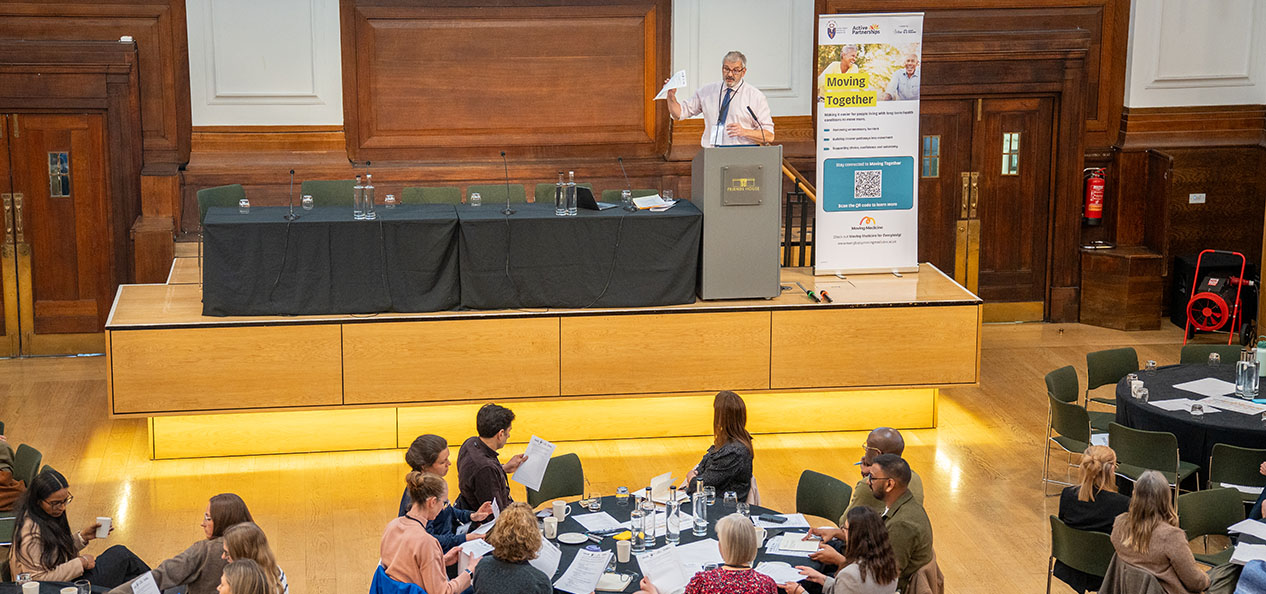
A man gives a presentation from a lectern to an audience seating around round tables in an indoors venue where there's also a Moving Together banner.

That’s exactly why Moving Together was created: a cross-sector initiative focusing on integrating physical activity into health and care, by creating frictionless pathways between health and physical activity, and by removing barriers associated with risk.

Launched in 2025, it is co-led by the Active Partnerships National Organisation and the Faculty of Sport and Exercise Medicine UK, and it's been supported and funded by Sport England through the National Lottery

Our ambition is to establish frictionless physical activity pathways to create an integrated system that offers proportionate support, enabling people living with long-term health conditions to develop the skills and confidence to build activity into their lives in ways that work for them. 

The importance of tackling this across sectors 

To achieve this aim, we are working across multiple sectors so that we can:

  • build and develop local areas where people can be active, while considering and meeting the individual needs of each community
  • define national evidence-based standards while learning from pilot models
  • establish and demonstrate a joined-up approach through health, activity practitioners and physical activity sector with brief advice, leading seamlessly to autonomous next steps
  • have impact in areas of health inequality.

Moving from medical clearance to cross-sector guidance

One of the barriers for people with long-term health conditions is risk aversion, but we are tackling this challenge head-on through research and evidence-based assessments that everyone involved can trust.

We want to drive change from mandated medical clearance to patient-centred medical guidance, as and when required, and we want to ensure this policy change is reflected in future physical activity pathway development. 

We’re already one year into this important programme and now we are embarking on our next phase. 

Our ambition is to establish frictionless physical activity pathways to create an integrated system that offers proportionate support, enabling people living with long-term health conditions to develop the skills and confidence to build activity into their lives in ways that work for them. 

A national roundtable conversation

On 14 May, we hosted an inaugural Moving Together National Roundtable in London, gathering more than 100 representatives from healthcare, physical activity, policy, academic, community and lived-experience organisations.

The event marked an important milestone in the Moving Together programme: it provided an opportunity to share progress, to test emerging thinking and to gather cross-sector perspectives on implementation in everyday practice.

Collectively we agreed priority actions across health and physical activity systems, and considered what the next phase of the programme should be.

Key themes we heard

The strongest message emerging from the event was that stakeholders are increasingly moving beyond asking whether physical activity should form part of long-term condition pathways, and are now focused on how implementation can happen consistently, safely and at scale. 

One key insight from the day was that the conversation has shifted from why physical activity matters to how implementation happens in practice.

From it, four key themes emerged: 

  • Workforce confidence – supporting professionals to have confident conversations about physical activity, risk and behaviour change. 
  • Practical implementation – ensuring resources, tools and support mechanisms exist to enable adoption in real-world settings. 
  • System alignment – strengthening connections between healthcare, physical activity providers, community organisations and policy partners.
  • Consistent messaging – ensuring individuals receive clear, evidence-based and empowering messages regardless of where they enter the system.

The discussions highlighted a strong appetite for change, alongside recognition that implementation support will be critical. 

It was also clear that we don't need more evidence that physical activity works and that we now need support to implement it consistently.

What’s next?

The passion and expertise in the room at the roundtable has fuelled our thinking about what’s next.

We know we won’t improve the pathways to help people with long-term conditions to move more without all of us driving behavioural change together, so we’re hosting a 45-minute webinar 'Maintaining Momentum: A Moving Together Update' on Thursday 9 July to keep going with our collaborative approach.

This webinar marks the next step in the Moving Together journey, sharing how feedback from a wide array of stakeholders is already shaping the programme's implementation priorities and future direction. 

I’m excited to be joining my fellow co-leads to share the latest update on how we intend to drive meaningful change, and we hope that people from both the health, care and physical activity sectors will join us to learn more about how they can support this important programme of work.

Participation is only part of the story

Pride Month provides an opportunity to celebrate visibility and community around the world.

But this time it is also an opportunity to reflect on what inclusion in sport and physical activity really means for Lesbian, Gay, Bisexual, Trans/Non-Binary and other Queer or Questioning (LGBTQ+) people.

Conversations about inclusion often focus on participation.

We want to know how many people are taking part, how often they are active or whether activity levels are increasing, but when it comes to answering these questions for LGBTQ+ communities, the picture is more nuanced than many might think.

What the data says

The latest Active Lives Adult Survey (November 2024–25) shows that some members of the LGBTQ+ communities are now more active than their heterosexual or cisgender peers.

However, one in three trans adults (33%), and just under one in three (30%) respondents who described their sexual orientation as ‘other’, are active for less than 30 minutes per week.

Additionally, LGBTQ+ people are also more likely to experience discrimination in sport and physical activity settings, and also less likely to report feelings of belonging in our local communities.

These findings challenge the assumption that LGBTQ+ inclusion in sport and physical activity has been achieved simply because certain activity levels look favourable.

The real work on LGBTQ+ inclusion is in ensuring that members of the communities can participate in environments where we feel safe, welcome and able to be ourselves.

LGBTQ+ people are also more likely to experience discrimination in sport and physical activity settings, and also less likely to report feelings of belonging in our local communities.

Accessible and Inclusive Futures

Earlier this week, we welcomed Lou Englefield from Pride Sports to lead a webinar for colleagues in the sector on LGBTQ+ inclusion as part of our Accessible and Inclusive Futures series, delivered in partnership with Inclusive Employers.

The session outlined the challenges LGBTQ+ people face across the sporting landscape and explored what organisations and individuals can do to improve cultures and environments, rather than just participation figures.

Being your whole self while being active

Lou talked us through Pride Sport’s research findings, which show that whilst many LGBTQ+ adults are active, we tend to favour solo pursuits such as walking, running, swimming or going to the gym, over team-based activities.

Additionally, those of us who do take part in traditional or team sports don’t always feel comfortable sharing our gender identity or sexual orientation with the teammates around us.

The figures were particularly stark for bisexual men and women, with only 22% and 26% respectively, reporting that either everyone, or most people, are aware of their sexual orientation in the sport they play.

Why this matters

The findings from Pride Sports matter because they highlight the hidden effort that many LGBTQ+ people put into deciding whether it is safe to be open about who they are.

Research on Minority Stress Theory shows that LGBTQ+ people experience stress from discrimination itself, but also from anticipating negative reactions and feeling the need to hide parts of their identity.

Different studies show that concealing your sexual orientation or gender identity can negatively impact wellbeing, whereas feeling able to be yourself is linked to better mental health outcomes and a stronger sense of belonging.

So, whilst many LGBTQ+ people might be achieving positive activity levels, they may not be experiencing all the social connectivity and wellbeing benefits that we know sport can provide.

Creating welcoming spaces

Creating more inclusive environments does not necessarily require large-scale programmes or significant investment.

It often begins with listening.

Organisations can start by building authentic relationships with LGBTQ+ communities and asking people directly about their experiences, needs and aspirations.

In our webinar, Lou suggested that organisations could start by reviewing the policies and processes that shape participants' experiences, including:

  • codes of conduct
  • membership and registration forms
  • equality, diversity and inclusion policies
  • trans and non-binary inclusion policies
  • safeguarding procedures
  • reporting and complaints processes.

The human role of creating inclusive cultures

As well as policies, people matter too and it is our coaches, volunteers, instructors, officials and front-line staff who often have the most significant influence on whether individual participants feel welcome.

Inclusive practice isn’t about having all the answers.

It’s about allyship and respect, as well as avoiding assumptions about identity, relationships or pronouns, using inclusive language and being open to learning from participants' experiences.

A welcoming coach or teammate can be what turns participation into belonging.

Looking ahead with Pride

Across the UK and Europe, LGBTQ+ sports clubs and events continue to create spaces where inclusion is built in, not bolted on.

Next year, Pride Sports will host the EuroGames in Cardiff, welcoming thousands of LGBTQ+ athletes to celebrate participation, diversity and belonging through sport.

Events like these remind us that the goal isn't simply to increase participation, but to create environments where everyone feels safe, respected and that they belong.

Because the true measure of inclusion is not just looking at who takes part – it's who feels they belong.
 

Find a LGBTQ+ or LGBTQ+ friendly club

Pride Sport's LGBT+ Club Finder

Creating active spaces for young LGBT+ people

For many people sport is associated with teamwork, friendship and confidence, but for lots of young LGBT+ individuals the experience of sport can be far less positive.

When I think back to my own experiences of school PE lessons, I remember often being one of the last people chosen for team sports.

Whilst many young people enjoy sport from an early age, others can come away feeling excluded, judged or simply that sport is not for people 'like them'.

A group of kids go down the river on their kayaks on a lightly cloudy day.

Research consistently shows that LGBT+ people participate in sport at lower rates than their non-LGBT+ peers and experiences of bullying, concerns about fitting in, fear of judgement and a lack of visible role models can all contribute to young people not engaging in physical activity.

This matters because sport and physical activity offer far more than physical health benefits – they provide opportunities to build friendships, develop confidence, improve mental wellbeing and create a sense of belonging.

The importance of positive role models 

At Mosaic LGBT+ Young Persons' Trust, we believe that every young person deserves the opportunity to experience those benefits and that is why physical activity has become one of our key strategic priorities.

Rather than expecting young LGBT+ people to adapt to environments where they may not feel welcome, we co-create spaces specifically designed to help them feel safe, supported and encouraged to participate.

Throughout the year, our members take part in a wide variety of low-level activities, such as ice skating, bowling, walking or cycling, to encourage them to be more physically active.

But what makes these experiences truly successful is not simply the activity itself, but the environment in which they take place.

Young people are surrounded by their LGBT+ peers, who share their experiences and are also supported by trained staff and volunteers too.

This environment is key because they get to see LGBT+ adults acting as role models and participating alongside them and, most importantly, they feel free to focus on enjoying the activity rather than worrying about whether they belong.

Rather than expecting young LGBT+ people to adapt to environments where they may not feel welcome, we co-create spaces specifically designed to help them feel safe, supported and encouraged to participate.

Mosaic Summer Camp can be a prime example of where it is taken to another level.

Each year, young LGBT+ individuals aged 12-17 spend a week together taking part in outdoor adventure activities, team challenges and sports that many have never had the confidence to try before.

Whether it is kayaking across a lake, abseiling off a cliff or building a raft, young individuals are encouraged to step outside their comfort zones in an environment built on acceptance and encouragement.

The results can be transformative and young people who arrive feeling anxious often leave having discovered new strengths, new friendships and a newfound confidence in their ability to participate in physical activity.

Trust and participation

What’s more, for many our summer camp becomes the first place where they experience sport without fear of judgment.

For our young adults, those aged 18–25, Pride Youth Games provides a similar opportunity.

The event brings together LGBT+ youth organisations from across the UK to take part in friendly sporting activities to have fun and to build community connections.

The emphasis is not on elite performance but on participation, on enjoyment and on the creation of positive experiences that’ll encourage lifelong engagement with physical activity.

These programmes demonstrate an important lesson for the wider sports sector: when young LGBT+ individuals are provided with welcoming, inclusive and supportive environments, participation follows.

The challenge is not fixing a lack of interest in sport, but ensuring that young people can access sport in spaces where they feel they belong and where they don’t have to worry about being LGBT+.

At Mosaic, we have seen firsthand how transformative those opportunities can be.

Sport has the power to improve health, strengthen communities and build confidence, so by creating environments where young LGBT+ individuals feel safe to participate, we can ensure that more young people experience those benefits and discover that sport really can be for them.

Find out more

Mosaic Trust

The foundation of an impactful youth voice

As we work alongside partners in Uniting the Movement, we have been deeply inspired by the brilliant youth voice initiatives across the sector that are supporting young people to make themselves heard. 

At the Leadership Skills Foundation, our own youth-voice journey is about reinforcing a core belief: that every young person can lead change if given the opportunity to develop their skills and confidence.  

Overcoming obstacles through communication

As part of our role as a Sport England system partner, we’ve been building understanding of the barriers young people face to accessing leadership opportunities and progressing into the sector's workforce. 

Youth voice has been an important part of this process and we’ve been testing a new accredited learning programme to empower young people to lead the conversation. 

The Speak Up Challenge aims to build young people’s skills and confidence through creative, participatory activities in classrooms, sports halls and youth clubs. 

Based on the Lundy model for youth participation, it gives young people a platform to communicate their views to influential professionals and policy-makers – all while also receiving feedback to help them understand the potential impact of their insights. 

As part of our pilot, colleagues at Sport England kindly agreed to listen and to provide video feedback as young people shared their perspectives on the barriers into sports volunteering and worked together to reimagine pathways into employment. 

Their ideas spanned transport difficulties, prohibitive costs, lack of role models, low confidence and negative perceptions of careers in sport. 

We’ve taken all the insights and created a summary for everybody to access and this is available on the Challenge page too. 

Our youth-voice journey is about reinforcing a core belief: that every young person can lead change if given the opportunity to develop their skills and confidence.  

Our journey so far  

Inspired by Sport England’s Youth Voice Innovation Storybook, we began by running co-design and consultation sessions in a variety of community and academic settings.

The young people we worked with were both energised by the opportunity to lead change and motivated by the potential to earn accredited recognition for their participation, but they also shared their concerns: 

  • Lack of time to commit to ongoing youth-voice activities. 
  • Worries about standing out amongst their peers or being visible online. 
  • Concerns around lacking the skills and confidence to make a difference. 

These insights helped form our core design principles: prioritise confidence-building, avoid long-term commitments, foster peer collaboration, protect privacy and recognise skill development through accreditation. 

We planned a small, iterative pilot to test and adapt as we learned during the first phase, and we were blown away by the depth of insights shared and the level of creativity displayed.

However, some less confident participants, particularly those from special educational needs and disability (SEND) and neurodivergent backgrounds, felt overly vulnerable and struggled to express their views.

Delivery staff reflected that participants needed more time to build trust and grow into the activities. 

Our second iteration focused more on building this base of skills and team rapport.

By improving scaffolding for mixed abilities, we saw positive signs that the programme was becoming more accessible and inclusive.  

Overall, our internal evaluation showed that 87% of participants believed the pilot helped them build skills to speak up for change, and the same percentage said they are now more confident speaking in front of others. 

These results reinforced our belief that the ability to form a viewpoint and effectively share it is a leadership skill that can be practiced, improved and recognised.  

Encouraging impact 

This project has strengthened our understanding of young people’s lived experiences and is informing how we design and deliver programmes for underrepresented groups. 

Participation has also had a meaningful impact on those involved.

It was a real joy to witness a room of boisterous 15-year-olds fall silent and react with smiles as they watched their views being addressed by colleagues from Sport England.

When we surveyed how they felt about the feedback, the overwhelming majority indicated they “definitely felt heard”.  

They were proud that their insights were taken seriously and this validation has acted as a springboard into other opportunities.

Following the challenge, we’ve seen participants inspired to launch online petitions for their MPs, to create new youth-led school clubs and to seek out other youth advocacy initiatives. 

Looking ahead 

As we move into the next phase of our development, we know we’ve still got some way to go, but we are excited to collaborate with other system partners to build on our learning and to support other related work from across the sector.  

Together we can make sure that every young person – regardless of background or circumstance – is able to lead positive change, so if you’d like to discuss our findings or how we can work together to empower young leaders to speak up, please contact us.  

We’re excited about continuing to grow together.

One team. One power. One dream

To some, 'devolution' might sound like a dry constitutional tweak – another layer of governance, another reshuffling of power. 

In reality, it’s actually far more human and ultimately, it’s all about people.  

For us in Greater Manchester, devolution has always been about who gets to shape the conditions of everyday life and about enabling those closest to the challenges to also have the power to solve them.

This is what drives us to go further and deeper on our devolution journey.

Facing reality

Back in 2009, the Manchester Independent Economic Review set out two stark truths.

Firstly that if the city-region acted as one joined-up place, it had the potential to help re-balance the UK economy; and secondly, that poor health in the area was holding people back from participating in that growth.  

In some of our neighbourhoods, healthy life expectancy still differs by more than a decade and access to employment, housing, green space and opportunity remains uneven.

These problems are one and the same because health and wealth inequalities are deeply intertwined, and physical inactivity is at the heart of it, yet this isn’t a result of personal choice but a product of environment, policy, culture and design work.  

Movement and physical activity have often been engineered out of daily life, especially in communities facing the greatest disadvantage.

By 2015, when the first Greater Manchester Moving strategy – Blueprint for Change  was developed, the data was clear.

Where inequality was top level, inactivity was also the highest; and the costs – financial, social and human – were enormous.

A true change of tactics against inactivity

The price of inactivity was at least £27 million a year and far higher if you took into account the cost of long-term conditions, mental health, social isolation and the impact of exclusion.  

The response couldn’t be another short-term campaign or an isolated programme. The people of Greater Manchester deserved better.

We needed to reshape the whole system – from transport to planning, from health to education and from workplaces to public spaces.  

This meant a shift from blaming individuals for being inactive and unhealthy (indeed 55% of people in our city-region wanted to be more active), to redesigning the conditions that were shaping their behaviour.

Movement and physical activity have often been engineered out of daily life, especially in communities facing the greatest disadvantage.

Devolution in Greater Manchester, along with the support of key partners like Sport England, has made that kind of systemic change possible.

This approach has made it possible to have power over health, transport, housing and skills for the people and places they affect but, more importantly, it has enabled us to work differently. 

The way we work now is rooted in collaboration across ten boroughs, public services, communities and sectors. We are one team! 

In Greater Manchester, prior to devolution, we already had the foundations and had laid the groundwork for this approach as we have a history of cooperation that stretches back generations. 

Devolution accelerated that instinct and drive as it gave us the space and opportunity to align strategies, pool resources and focus on our shared mission of building a thriving city-region where everyone can live a good and active life. This is making a difference.

Evidence suggests that life expectancy has improved faster than expected since devolution, particularly in more deprived areas.  

Employment, school readiness and public health outcomes have all shown signs of progress.  

In terms of physical activity, Greater Manchester reduced inactivity at nearly three times the national rate before the pandemic and has since recovered more quickly.

The latest data shows that in Greater Manchester, 62.1% of adults are now considered active. This is the highest rate ever recorded and there is further progress too, with inactivity falling to 26.9%, down from 28.3%.

Data shows that activity levels for children and young people in Greater Manchester are also the highest they’ve been since the survey began in 2017 and, currently, 50.1% of those aged 5-16 are active for at least 60 minutes a day.

But inequalities remain, particularly for people living in more deprived areas, lower socio-economic groups and for some ethnic communities.

So, while this is encouraging progress, a continued focus is needed to enable active lives for all and to keep the MIER report front of mind.

Moving forward as one

These changes are the result of systems that are maturing, where there is better alignment between local and regional strategies, stronger partnerships, and growing trust across sectors.  

They also reflect a deep cultural change in leadership that drives everything we do.

Here, leadership is more than job titles and institutions – it’s relational, distributed and rooted in a shared purpose. 

Leadership seen in community groups is as important as that of boardrooms because, for us, it is about convening, listening and connecting. 

We are united by the same goal of helping people see how movement links to the issues they care about, from jobs and growth to mental health and climate.

Devolution supports us in this work, but it doesn’t guarantee it. Local power alone isn’t enough and mindsets, behaviours and relationships matter just as much.  

The instinct to collaborate doesn’t come from governance structures alone – it comes from people and that’s the real lesson here.

Whether a place has formal devolved powers or not, the fundamentals still apply and it all starts with a shared vision.  

We use a central community voice, work collaboratively across boundaries and build trust by aligning efforts around outcomes that matter.

Our journey in Greater Manchester’s is far from finished (we are only five years into our 10-year Active Lives for All strategy), but we are an example of what is possible when a place brings together its people, purpose and power. 

To my mind, devolution isn’t about redrawing maps. It’s about redesigning systems so that everyone – regardless of where they live – has a fair chance at a good life.

Breaking barriers for deaf sport

Growing up as the only deaf person in my family, sport became my escape from the loneliness and isolation I often felt at home and at school, because constantly second-guessing conversations and struggling to keep up takes a toll.

But sport gave me freedom and a way to let go of all that frustration.

It all started with swimming. In the water I found my own bubble of silence. No worrying about misheard words or asking people to repeat themselves – just me, the lane and a sense of independence.

That feeling is something every child should have, but for many deaf children the chance to experience it simply isn’t there.

A girl wearing a hearing device passes a ball with a coach on an indoors court under the supervision a woman holding a folder.

The reality we don’t talk about enough

Deafness is often called 'the forgotten disability' and it’s easy to see why.

According to data by the National Deaf Children’s Society there are more than 18 million deaf and hard of hearing people in the UK, including 54,000 children, yet the challenges they face go far beyond communication.

Social isolation is common and that often leads to mental health struggles and inactivity.

The results of Sport England’s Active Lives Surveys painted a stark picture:

  • 51% of deaf adults are inactive, compared to 20% of non-disabled adults
  • 38% of inactive deaf adults don’t take part in sport at all, compared to 10% of inactive non-disabled adults
  • among less active children, 36% of deaf children do no activity at all, compared to 27% of non-disabled children.

These numbers support why tackling inequalities isn’t just a nice idea – it’s essential – and it’s exactly what Sport England’s strategy is all about.

There are more than 18 million deaf and hard of hearing people in the UK, including 54,000 children, yet the challenges they face go far beyond communication.

Destination Deaflympics: turning inspiration into action

In 2025, we launched Destination Deaflympics, a programme for 8-16-year-olds inspired by the Tokyo 2025 Deaflympics.

For us it’s all about giving young people the chance to try fun, inclusive activities and closing the gap between deaf children and their hearing peers.

So far we’ve reached 3,500 deaf and hard of hearing children across 175 settings and, along the way, we’ve learned a lot about the barriers they face, like the lack of accessible community provision or coaches who don't know how to deliver inclusive sessions.

That’s why we’re working with partners like the British Association of Teachers of Deaf Children and Young People to make sure deaf children get their recommended 60 minutes of activity every day.

This work has seen great success in the education sector with teachers sharing that by taking part in Destination Deaflympics, they are also seeing benefits in the classroom with students being more focused and ready to learn.

Role models who make a difference

The Deaflympics celebrated its 100th anniversary in 2024 and the Tokyo Games was an event like no other.

The GB team brought home 12 medals, finishing 12th out of 80 nations, but its impact went way beyond the results.

These athletes are key role models who showed what’s possible and inspired the next generation of Deaf sport men and women.

Before the Games, one of our swimmers spent a day with deaf schoolchildren in Greater Manchester sparking excitement and ambition that will last a lifetime.

Why this matters for Sport England’s vision

Everything we’re doing supports Sport England's long-term strategy, Uniting the Movement. We're talking about things like:

  • tackling inequalities by addressing the participation gap in sport for deaf people
  • creating inclusive environments through coach education and community partnerships
  • improving mental wellbeing by using sport to combat isolation
  • building role models who inspire young people to dream big.

Sport should be for everyone and that’s why, by breaking down barriers and creating opportunities, we’re not just changing lives – we’re helping deliver Sport England’s vision of a fair, inclusive and active nation.

Find out more

UK Deaf Sport

The changing-climate threat

I can’t wait for the Commonwealth Games, which this year will be held in Glasgow at the end of July, and to the much-needed uplifting news and excitement they’ll bring us.

The games are an opportunity for athletes from across the Commonwealth to compete at the highest level and for people everywhere to enjoy the spectacle, which will extend over 11 days of sport and festivities.

But among all the excitement we can't forget that for some of the athletes, actually getting to the point of competing has been tough and the effects on their training by climate change means it’s only getting tougher.

The dangers of acute weather conditions 

For instance, on the Maldives, sea-level rise is a real problem with saltwater encroaching on facilities and extreme weather stopping play, whereas in India it’s simply too hot to train in the summer, so its athletes must live and train elsewhere if they want to compete.

For those still unsure about the impact of climate change on sport, it’s worth attending a screening of the National Emergency Briefing and having a look at The Well-Adapted UK report, as both documents warn us about the importance of preparing for new temperatures, extreme rainfall and the changing of the seasons.

Sport and physical activity are threatened by a changing climate, not just at elite level but at grassroots level too.

As winters become wetter we are seeing pitches and courts flooded with increasing frequency, leaving them unusable for any training, competition or enjoyment.

Conflict elsewhere is another factor affecting our sector, as it’s leading to wildly fluctuating energy prices that threaten the clubs and sports organisations’ ability to keep the lights and heat on in the facilities, something that particularly affects swimming pools.

And as we approach the summer we'll see how extreme heat is increasingly going to be a key threat, particularly for disabled people, the elderly or those with a long-term health condition.

Plus for those living in densely-populated areas, the lack of shading will deter people from taking exercise as it’s hard for many to be active when the heat makes you ill.

Sport and physical activity are threatened by a changing climate, not just at elite level but at grassroots level too.

Given that during the Covid pandemic physical activity was one of the few legitimate reasons we were allowed to leave our homes – along with essential shopping, medical needs and travel to work for key workers - it is clear how important exercise is to individuals and to any nation.

That realisation has become an accelerator for action and it’s encouraging that we are starting to work on measures to reduce our impact on the environment, to stop climate change getting any worse, and – just as importantly – to plan for the future.

Here at Sport England we are developing a report, which should be available by late summer, looking at the hazards caused to sport and physical activity by a changing climate.

But while there’s still work that needs to be done, it’s reassuring that people are considering climate change and that we’re are already taking action. 

This is only a first step because we know we need to understand how this will vary across the country, how it’ll affect different activities and – perhaps more importantly – how different people and communities will behave in more extreme weather conditions. 

The King's Baton Relay

I could see this when I visited Malmesbury Bowls Club earlier this month as part of the King’s Baton Relay, which sees delegates of the 74 competing nations and territories travel across their home lands before finishing at the host city of the Commonwealth Games, Glasgow. 

I was there with Sally-Ann Lewis-Wall, representing Team England in para-bowls at the Games, and with TV presenter Radzi Chinyanganya, to hear about the importance of sport at both elite and grassroots level being more sustainable and preparing for the future.

It was great seeing the work done, supported by our Movement Fund, to install an artificial green and then restore it when it was damaged by severe flooding last year.

The bowls club are working with others in the area to take a wider look at the flooding issue.

They have identified tree-planting and other nature-based solutions upstream to slow the flow of water to the town to enable play to continue, meaning that the members of the club will be able to keep enjoying the exercise and the good company. 

It is with thousands of these small actions across England and the Commonwealth that we can ensure we’ll all be able to keep enjoying sport and activity now and into the future.

Every little win against climate change counts and I, for one, will be watching the Games closely and listening out for other inspirational projects.

Dancing against dementia

I co-founded Dementia Disco back in 2019 along with my brother Nick and our friend Phil as we all shared the heartbreak of watching family members live with this terrible condition. 

Mine and Nick’s dad was diagnosed with Alzheimer’s at just 66 and while local support groups used music, they often played songs from the 1940s and 50s that meant very little to a man born in 1950 and who grew up loving the 60s and 70s.

Meanwhile, Phil watched her independent, piano-playing gran quickly fade due to vascular dementia, realising that losing someone to this condition means losing them twice.

Men and women of different ages smile as they dance indoors.

Reaching beyond with music

Determined to create a space where people could connect with the memories of who their loved ones truly are, we launched Dementia Disco. 

Our project filled a vital community gap by hosting free weekend discos playing iconic music that resonated with younger people living with dementia, but also allowing multiple generations to dance together, while giving carers a well-deserved rest. 

We now have eight monthly discos nationwide, reaching as far as London in the South to Northumberland in the North, and with five more in the pipeline. 

We also bring our discos into care homes across the North West and are branching out in Northumberland. 

There's a moment at our Dementia Disco sessions that never fails to send shivers down your spine.

It happens when a familiar song starts to play and, suddenly, the room transforms.

We have watched music and dancing unlock communication where words have failed, and to restore lost confidence and dramatically lift the moods of people living with dementia, their carers and their families.  

Music has an extraordinary power because it bypasses the cognitive barriers of dementia and taps straight into emotion and memory.

However, while our regular community discos bring immense joy, we quickly noticed a bittersweet challenge – the profound benefits were limited to the days we met. But what about the rest of the week? 

Our project filled a vital community gap by hosting free weekend discos playing iconic music that resonated with younger people living with dementia, but also allowing multiple generations to dance together and giving carers a well-deserved rest. 

We wanted to give our community, of over 400 disco-goers, access to daily engagement while providing care homes with accessible, repeatable physical activity resources.  

This purpose lead us to asking ourselves a key question: how do we take that magical, weekly disco energy and turn it into a simple, life-changing daily habit?  

The hidden danger: tackling falls 

The answer became urgent when we looked at one of the most serious health risks facing people with dementia: falls.

Falls are the leading cause of emergency hospital admissions for older people, costing the NHS £2.3 billion annually, and they drastically accelerate the loss of independence.

Because of a fear of falling, many people with dementia become less active, but this only makes them weaker and more vulnerable.  

We wanted to break this cycle by embedding clinically-proven strength and balance exercises into joyful, familiar dance routines.  

Where science meets boogie

Thanks to the support from the Sport England Movement Fund, that dream is now a reality and we have teamed up with the brilliant Ailsa McPhee and her project, The Daily Dance, to co-create 240 brand-new dance videos over the next 12 months.  

The opportunity here is massive, because we’re not just making dance videos – we are transforming clinical therapy into a daily celebration.  

To ensure the highest physical impact, we have partnered with KOKU Health Ltd, a University of Manchester spinout.

Endorsed by Prof Emma Stanmore and Dr Jaheeda Gangannagaripalli, our routines seamlessly integrate the university's award-winning, evidence-based falls-prevention exercises, as decades of research prove these movements can reduce falls by up to 42%.

This all comes to life with Ailsa as she beautifully weaves these targeted balance and strength movements into high-energy, themed choreography sets to well-known songs.

Participants get the medical benefits of a specialised falls-prevention programme, but to them, it just feels like having a brilliant boogie.  

Turn on Dementia Disco TV 

This week is Dementia Action Week and while it's key to celebrate, we want to make daily physical activity achievable for everyone and everywhere, so all our 240 videos are being hosted directly on our brand-new digital hub, Dementia Disco TV.

Whether it’s a short warm-up before breakfast at home, a midday mood-booster with a family member, or a group session in a care home, these routines are free, evergreen, and designed to be easily woven into any daily schedule. 

Over the next year, we will be exploring different dance styles, seasonal themes (from summer holidays to Christmas), and fun costumes to keep our dancers inspired and connected all year round.  

We are incredibly grateful to Sport England and the National Lottery players for making this project possible, because combining emotional engagement with robust health science, we’re not just helping people stay active – we are giving them the confidence, strength and joy to live their lives to the fullest, one dance step at a time.  

More than a walk

If you’ve ever wondered whether a simple walk can really make a difference to someone’s life, the answer from our Somerset Health Walks community is a huge ‘yes’.

Over the past year, we’ve been gathering feedback from over 3,000 of our individual walkers and over 180 volunteers to better understand the impact that our Health Walks programme is having across Somerset.

But while the statistics are important, it’s the personal stories and comments that really bring everything to life – and honestly, they’ve been some incredibly moving tales to read.

One thing that shines through again and again is how welcoming and inclusive our walks feel.

A group of people walk in smalls groups on the street on a sunny day.

The power of walking together

People consistently describe the groups as friendly, supportive and completely non-judgemental – something we’re really proud of.

For many, joining a walking group can feel daunting at first.

Some are managing long-term health conditions, some haven’t exercised in years and others simply feel nervous about turning up alone.

But walkers told us they value the fact there’s “absolutely no pressure to participate”, that “nobody gets left behind” and that this culture of kindness matters as, for many walkers, these weekly meetings have become an important part of their life.

Why? Because these strolls aren’t just about steps or fitness levels – they’re about motivation, connection and about creating healthy habits that last. 

Many walkers told us the groups help them feel part of a community, especially those who live alone or are new to an area and that sense of belonging is incredibly powerful.

This is because what starts as a walk often evolves into grabbing an after-walk coffee, with chats that make those encounters become friendships that then turn into support networks. People arrive as strangers and quickly become familiar faces to one another.

Of course, there are physical benefits too – and they’re significant.

Good for body and mind

Among walkers with long-term health conditions, many reported improvements in overall fitness, mood, mobility and wellbeing after taking part regularly.

We also saw encouraging signs that people are becoming more active overall, including doing more balance and strength activities.

But again, it’s the way people describe those changes that really matters.

They say things like: "The whole experience makes me feel healthier and happier", "[walking] keeps us fit, mentally and physically!" or "I feel so much happier when I have been on my health walk."

These comments perfectly sum up why programmes like this are so important.

These strolls aren’t just about steps or fitness levels – they’re about motivation, connection and about creating healthy habits that last. 

Another lovely theme that emerged was people reconnecting with their local area.

Walkers told us they’d discovered footpaths, countryside routes and places they never knew existed.

Enjoying our local spaces

Others spoke about the joy of being outdoors in all seasons – being out in fresh air, nature, muddy boots and all – plus the recent study by Current Psychology confirms that walking in natural environments significantly improves mental wellbeing.

As always, we’ve also listened carefully to suggestions and feedback, and over the past year we’ve introduced more walks in different locations, added clearer meeting point information and improved details on our website to make walks easier to access.

Walking is a favourite activity for many people and why wouldn’t it be here in our beautiful county?

It’s important to us that Somerset Health Walks continues to grow and evolve with the needs of our community. That’s what working in Place is all about.

The investment from Sport England is important, but working in this way has only been made possible by our incredible volunteers and walk leaders.

The warmth, professionalism and care they bring every single week is what makes these walks so special.

And, of course, the walkers themselves. They are what make this community what it is and why we carry on working together in this way. See you on the next walk!

Find out more

Somerset Health Walks

You've viewed of items.