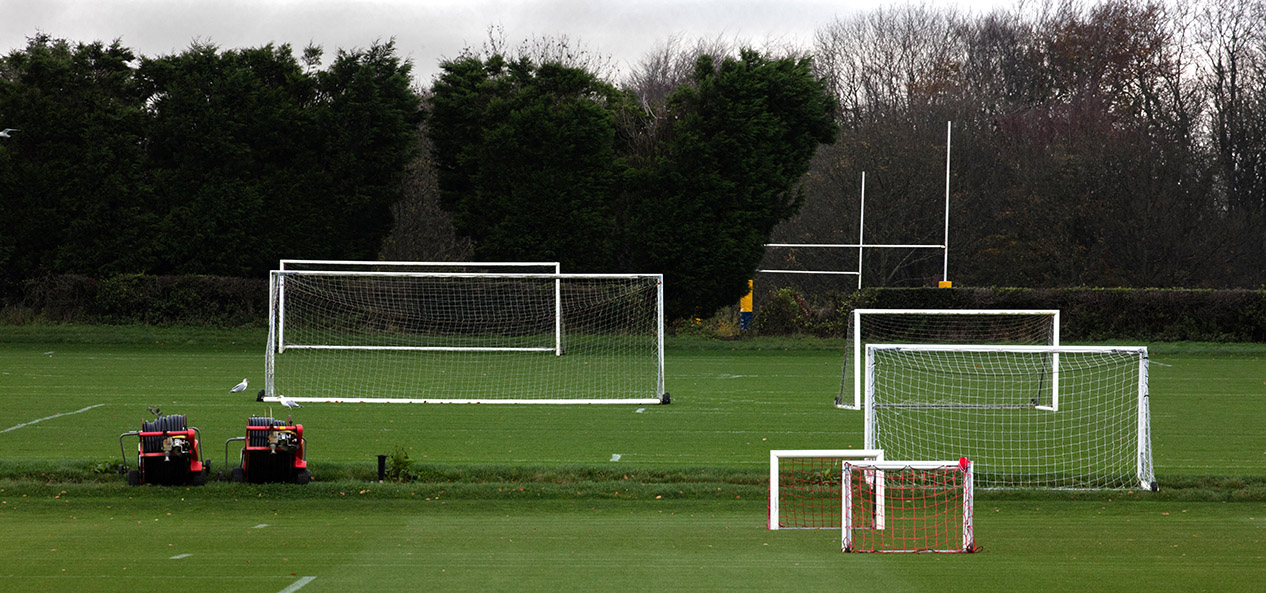
A running shot along the touchline of a playing field, initially focused down on the line, before panning up to the wider horizon.
Voice of Alex Welsh, chief executive of The London Playing Fields Foundation: At London Playing Fields Foundation, we say that playing fields are where sport begins.
Aerial shot of the playing fields, with two blue astroturf pitches to the left hand side, and housing to the right and in the distance.
Cuts to the legs of two boys playing football. Cuts to a wider shots of their whole bodies, and the others involved in the game.
Getting people to be more active, persuading young people to join sports teams rather than gangs.
Cuts to a shot of someone cleaning football boots in a tub of water, while a football goal is wheeled behind them.
Close up of the boots being cleaned.
Oakfield provides such a wonderful benefit to the local community.
Cuts to an adult male football match, with a defender clearing the ball.
Cuts to a clubhouse, with screens in the background playing football on them, while players socialise at the tables.
Cut to a talking head of Alex Welsh.
Why are we even thinking about losing these places?
Cut to a low shot of the grass of the fields.
Voice of Andy MacRae, Bealonians FC: There’s lots of theses about the benefits of sport and how it just brings everyone together across all dimensions of society.
Cut to the football goal continuing to be wheeled across the field.
Cut to talking head of Andy MacRae, with the playing fields in the background.
Cuts to another shot of players socialising in the clubhouse, around a table.
It makes a massive difference to mental health of everybody, of all ages.
Cuts to the legs of a footballer dribbling the ball down the wing, before cutting inside and the shot opening up to see a defender sliding in to make a tackle.
Voice of Chris Nutt, secretary of Save Oakfield Society: The immediate threat to Oakfield is that the council will try to avoid giving us a long-term lease.
Cut to talking head of Chris Nutt.
Cuts to an aerial shot of the playing fields, with homes in the background.
Cuts to a shot of a groundsman driving a ride-on lawnmower across the fields.
That means that we’re constantly concerned about whether we’re here or not.
Cut to a talking head of Chris Nutt.
That’s not good for the membership, for the local community, for anyone.
Cuts to an overhead shot of the neighbouring homes, showing how their gardens back onto the playing fields.
Cuts to the clubhouse tower, upon which is the club crest of Bealonians FC, then to the side of the building, with players walking past a sign saying welcome to the ‘Jack Carter Pavilion’ home of Bealonians Football Club.
Voice of Andy MacRae: This is our area, this is our community, there’s nowhere else for us to really go.
A man carrying kits bags, bags of balls, etc. walks past the pavilion.
The groundsman drives the lawnmower.
Voice of Alex Welsh: Once a playing field is lost, it’s lost forever. It’s not coming back. There are no second chances.
Cuts back to Alex Welsh.
Cuts to a wide shot of a young boy taking a corner kick, before cutting to the box, where attackers jostle with defenders for the ball.
But we have to work together. We’ve got to stand shoulder-to-shoulder in the years to come.
Adult players warm up on the side of a pitch.
A coach kneels down with a group of young players, who are kneeling in a circle around him.
Cut back to Chris Nutt.
Voice of Chris Nutt: We’ve overcome a whole series of challenges in the past.
Cut to a series of team photos of men’s teams.
We had a Parliamentary petition signed by 7,000 people. We kept going. We didn’t let it out of our sight.
Cut to a banner attached to a fence that reads: Support Oakfield Society & Barkingside 21. Keep green belt sports for our children and community. Protect your Oakfield from the council.
Voice of Alex Welsh: We’re really worried that Oakfield is going to be lost.
Back to an aerial shot of the playing fields, with the blue hockey pitches in the middle of the shot.
Another aerial shot, panning over the fields, with the hockey pitches in the left of shot.
Voice of Chris Nutt: Playing field like this make a great deal of difference to people who are working hard in the week, or at school in the week, or are concerned or are lonely on their own.
Cut to Chris Nutt.
Cut to photos of users of the playing fields, receiving various awards – one including the Bobby Moore Award.
They can come here. Friends I met when I first joined the club, I’m still with 60 years later.
Cuts to an aerial photo of the fields.
Cut to Chris Nutt.
Cuts to a male adult football match, then to the players shaking hands in the pavilion after the match.
Voice of Alex Welsh: We can’t afford to lose any more, and that’s why protection comes first.
Cuts back to Alex Welsh.
I’ve seen with my own eyes how playing fields can bring the joy of playing sport.
Cuts to an adult male match, with a winger putting in a low cross, that’s converted by the attacker in the box for a goal, both of them wheel away to celebrate.
Cuts to a diverse group of adults socialising in the pavilion after a match.
I’ve seen how it can tackle inequalities and I’ve seen on an individual level how it can build confidence, resilience, bring people together to bring hope where previously there was only despair.
Cuts to a group of young boys, shaking hands after a match.
Cuts back to Alex Welsh.
Cuts to a series of old photos of the fields being used over the years.
Voice of Chris Nutt: The end game is to Keep Oakfield safe. That’s what we’re aiming for. That’s what we’re doing. No doubt that’s what we’re going to achieve.
Cuts to Chris Nutt.
Cuts to more socialising in the pavilion.
Voice of Alex Welsh: The laughter, the cheering, the encouragement, sometimes the commiseration.
Cuts to players in a huddle, warming up before a match.
Back to Alex Welsh.
But it’s the memories that they have, and it’ll last them a lifetime.
Cuts to a final aerial shot of the playing fields, with a white Sport England logo in the middle of the screen